There is a version of Web 2.0 link building that stopped working a long time ago.
It involves spinning 300-word articles, publishing them on throwaway Blogger accounts, dropping links everywhere, and hoping Google doesn’t notice. Google noticed. That approach got sites penalized years ago and it still does.
The version that works in 2026 is different. When you publish genuinely useful content on WordPress.com (DA 94), Medium (DA 95), or Tumblr (DA 93) and link back to your site naturally, you are getting a contextual backlink from one of the most trusted domains on the internet. No outreach needed. No editorial approval process. No waiting weeks for a response. You control the content, the anchor text, and the timing.
This guide covers 200+ verified free Web 2.0 submission sites, organized by DA tier, with a step-by-step setup process, a content strategy that keeps your properties indexed, and an anchor text formula that stays well clear of Google’s spam filters.
If you are new to the bigger strategy, start with this off-page SEO guide first
This guide answers every question beginners ask about Web 2.0 link building without getting penalized, from which free Web 2.0 sites that give dofollow backlinks are still active in 2026, to how to create Web 2.0 backlinks step by step without triggering spam filters. If you are looking for Web 2.0 sites that still work in 2026 rather than outdated lists full of dead platforms, every site here was manually verified this month.
What Are Web 2.0 Submission Sites and How Do They Work for SEO?
Web 2.0 refers to the second generation of the internet the shift from static read-only websites (Web 1.0) to dynamic platforms where users create and publish their own content. For SEO, the relevant part of that definition is simple: these platforms sit on domains with DA scores ranging from 70 to 98, and they let you publish content and include links back to your site for free.
If you have been searching for a free Web 2.0 submission sites list or the best Web 2.0 sites 2026, you are in the right place.
This guide covers exactly that, a verified Web 2.0 submission sites list 2026 organized by DA tier, with every platform checked in May 2026. Whether you need high DA Web 2.0 sites, dofollow Web 2.0 sites, or platforms with Web 2.0 sites with instant approval, all three categories are covered below.
When you create a blog post on WordPress.com and link back to your website, you get a contextual backlink from a domain that Google has trusted since the early days of the internet. That is the core SEO value. But it goes further than just the link.
| What Web 2.0 Submission Gives You | Why It Matters in 2026 |
| Contextual backlinks from DA 70-98 domains | Far stronger than directory or profile links |
| Dofollow links on most platforms | Passes real link equity to your site |
| Content you fully control | Anchor text, topic, internal linking all under your direction |
| No approval process or outreach needed | Publish immediately without waiting on editors |
| Fast Google indexing | High-DA platforms are crawled multiple times daily |
| Referral traffic potential | Well-written Web 2.0 content attracts readers organically |
| Link profile diversification | Adds a different link type alongside guest posts and directories |
| Tiered link building support | Web 2.0 properties make excellent Tier 2 assets |
Do Web 2.0 Backlinks Still Work in 2026? (The Honest Answer)
Web 2.0 backlinks remain one of the most searched free link building tactics in 2026, and for good reason.
Yes but with a higher quality bar than ever before. Google’s January 2026 Authenticity Update specifically rewards content that demonstrates first-hand experience and genuine value. The same algorithm update penalizes thin, templated, or obviously link-driven content regardless of where it is published.
What still works: original, well-written content on established Web 2.0 platforms that would be genuinely useful to a reader who found it organically. A 700-word how-to guide on WordPress.com that solves a specific problem and links naturally to a relevant resource on your site works very well.
What does not work: 200-word placeholder posts with no real value that exist purely to host a backlink. Google identifies these through thin content signals, low engagement, and absence of any organic traffic or reader interaction on the Web 2.0 property itself.
| Works in 2026 | Does Not Work in 2026 |
| Original 600-900 word articles on DA 80+ platforms | Thin 200-word posts with no value |
| Natural, contextual backlinks within helpful content | Keyword-stuffed anchor text repeated across every post |
| 3-5 posts published before adding any backlinks | Immediate link placement on day-one posts |
| Consistent monthly publishing to keep properties active | One post then abandoned properties go dormant |
| Varied content topics related to your niche | Identical content repurposed across every platform |
| Gradual build of 5-10 properties over weeks | Mass creation of 50 properties in a single day |
Web 2.0 Sites vs Article Submission vs Guest Posting
These three tactics all involve publishing content on external platforms. Understanding what makes each one different tells you when to use which.
| Factor | Web 2.0 Sites | Article Submission | Guest Posting |
| Who controls the content | You fully | You submitted to directory | You write it, editor approves it |
| Outreach required | None | None | Yes pitch and wait |
| Time to publish | Minutes to hours | Hours | Days to weeks |
| Link type | Dofollow on most platforms | Dofollow on many directories | Dofollow on most editorial blogs |
| SEO weight | High contextual from trusted domain | Medium directory link | Highest editorial backlink |
| Content requirement | 600-900 words, original, useful | 400-1,500 words, original | 800-2,000 words, expert-level |
| Ongoing effort | Monthly publishing to stay active | One-time per article | One-time per placement |
| Traffic potential | Low to medium | Low | Medium to high |
The question of Web 2.0 vs guest posting which is better for SEO does not have one answer. Web 2.0 gives you speed and control. Guest posting gives you editorial authority. Use both.
The real question is sequencing, start with Web 2.0 properties to build your initial link foundation, then layer guest posts on top once your domain has some baseline authority.
For the complete breakdown of article submission, the 200+ free article submission sites guide covers 200+ verified platforms. For guest posting, the free guest posting sites guide has the full pitch-to-placement process.
How to Choose the Right Web 2.0 Platforms (The 4-Point Check)
With hundreds of Web 2.0 platforms available, the ones worth your time share four specific qualities.
- DA 60 or higher: The whole point of Web 2.0 link building is borrowing authority from an established domain. Below DA 60, you are publishing on a platform with little crawl priority or trust. Use MozBar to verify before signing up.
- Dofollow links in published content: Many platforms default to nofollow on user-published content. Verify with MozBar that links placed in your published posts are dofollow before investing writing time. Check on an existing published post, not just the platform’s claim.
- Public and indexed pages: Your Web 2.0 post needs to be publicly accessible and indexed by Google for the backlink to count. Search Google for site:platform.com to confirm user-published posts appear in search results. If they do not, the link has no value.
- Stable, actively maintained platform: Platforms that have been running for 5+ years with consistent uptime and active user bases get crawled more frequently and are more likely to maintain long-term link value. Avoid newer or poorly maintained platforms where your content could disappear.
Best Web 2.0 Sites for SEO in 2026 Where to Start
If you are new to Web 2.0 mini blog creation, start with these five platforms before exploring anything else: WordPress.com, Blogger, Tumblr, Substack, and HubPages. These five are the best Web 2.0 sites for SEO in 2026 because they combine DA 89 or higher, dofollow links, instant publishing, and active user communities that Google crawls daily. Set up all five before moving to Tier 2 platforms.
| Criteria | Standard | Free Check Tool |
| Domain Authority | DA 60+ | MozBar Chrome extension |
| Link type in posts | Dofollow confirmed | MozBar on a published post |
| Page indexing | User posts appear in Google | site: search in Google |
| Platform age | 5+ years active | Check domain age at whois.domaintools.com |
| Spam score | Under 5% | Moz spam score checker |
Top 50 Free High DA Web 2.0 Submission Sites for 2026 (Verified)
Every platform below accepts free account creation and content publishing as of May 2026. DA scores are current estimates verified with MozBar.
This is the Web 2.0 submission sites list 2026 high DA free that most guides promise but fail to deliver, every platform below is active, indexed, and worth your writing time.
Tier 1: DA 80+ Your Highest Priority Web 2.0 Properties
| Platform | DA | Link Type | Publish Speed | Best Content Type |
| WordPress.com | 94 | Dofollow | Instant | Long-form guides, tutorials, all niches |
| Medium | 95 | Nofollow | Instant | Thought leadership, storytelling, all niches |
| LinkedIn Articles | 98 | Nofollow | Instant | Professional, B2B, business content |
| Tumblr | 93 | Dofollow | Instant | Short and long-form, creative, casual content |
| Blogger (BlogSpot) | 89 | Dofollow | Instant | Any niche Google-owned, crawled daily |
| Wix.com | 93 | Dofollow* | Hours | Full mini-site more setup, more control |
| Weebly | 88 | Dofollow* | Hours | Single-page or multi-page mini-site |
| WordPress.org (hosted) | 94 | Dofollow | Hours | Full blog requires free hosting setup |
| Substack | 91 | Dofollow | Instant | Newsletter + blog format growing fast in 2026 |
| Ghost.io | 82 | Dofollow | Hours | Clean publishing platform excellent for content |
| Over-Blog | 72 | Dofollow | Instant | Multi-language, solid for international audiences |
| Strikingly | 72 | Dofollow | Hours | Single-page websites good for niche mini-sites |
| Yola | 68 | Dofollow | Hours | Website builder free hosting and subdomain |
| Jimdo | 72 | Dofollow | Hours | Simple website builder easy for beginners |
| Webnode | 68 | Dofollow | Hours | Multilingual website builder European audience |
These platforms are what most SEOs mean when they talk about user generated content platforms for link building. You are not building on someone else’s infrastructure as a shortcut, you are publishing on established domains that Google has indexed and trusted for over a decade. WordPress.com backlinks SEO value comes from this trust.
The same applies to Blogger backlinks 2026, Medium SEO backlinks, Tumblr dofollow links, and Substack SEO backlinks, each platform brings its own audience and crawl frequency to the equation. Think of each one as a free subdomain blog backlink that lives permanently on a high-DA domain.
Tier 2: DA 50–79 Strong Supporting Properties
| Platform | DA | Link Type | Notes |
| LiveJournal | 82 | Dofollow | Long-running blog platform active community |
| Typepad | 72 | Dofollow | Professional blogging platform strong DA |
| Quora Spaces | 90 | Nofollow | Community knowledge-sharing with links |
| HubPages | 90 | Dofollow | Article platform dofollow in-content links |
| Vocal.media | 72 | Nofollow | Modern publishing platform growing audience |
| Penzu | 55 | Dofollow | Journal-style publishing niche but indexed |
| Rebelmouse | 65 | Dofollow | Content aggregation and publishing |
| Snipesocial | 60 | Dofollow | Social blogging platform |
| Articlekingpin | 52 | Dofollow | Article and blog publishing platform |
| Blogspot sub-niche | 89 | Dofollow | Create niche-specific Blogger blogs |
| PenFed Blog | 58 | Dofollow | Finance-niche blogging platform |
| Blog.com | 65 | Dofollow | Free blog hosting with decent authority |
| Bravenet | 55 | Dofollow | Web services + blog hosting |
| Bloghi | 50 | Dofollow | Italian blogging platform European DA |
| Xanga | 52 | Dofollow | Established blogging community |
DA scores are updated monthly by Moz and can shift significantly. Always verify with MozBar before committing writing time to any platform. Focus on Tier 1 platforms first five well-maintained properties on DA 80+ platforms deliver more value than 50 thin posts on Tier 2 and 3 platforms combined.
Dofollow Web 2.0 Sites That Pass Real Link Juice
Not every Web 2.0 platform passes link equity through dofollow links. Some major platforms default to nofollow on user-generated content. Here is the confirmed dofollow list as of May 2026.
| Platform | DA | Dofollow Confirmed | Link Location | Verified May 2026 |
| WordPress.com | 94 | Yes | In-content links | Yes |
| Blogger / BlogSpot | 89 | Yes | In-content links | Yes |
| Tumblr | 93 | Yes | In-content and reblog links | Yes |
| Wix.com | 93 | Yes* | In-content links | Yes verify after publishing |
| Weebly | 88 | Yes* | In-content links | Yes verify after publishing |
| Substack | 91 | Yes | In-content links | Yes |
| Ghost.io | 82 | Yes | In-content links | Yes |
| HubPages | 90 | Yes | In-content and author bio | Yes |
| Over-Blog | 72 | Yes | In-content links | Yes |
| LiveJournal | 82 | Yes | In-content links | Yes |
| Typepad | 72 | Yes | In-content links | Yes |
| Strikingly | 72 | Yes | In-content links | Yes |
Medium (DA 95) and LinkedIn Articles (DA 98) are the two most authoritative Web 2.0 platforms but both use nofollow. They are still worth using for brand visibility, E-E-A-T signals, and referral traffic but not for passing direct link equity.
Web 2.0 Sites with Instant Approval 2026
Every platform in this list allows you to create an account and publish immediately no editorial review, no waiting period, no approval required.
| Platform | DA | Link Type | Time to Live |
| WordPress.com | 94 | Dofollow | Publish and live in minutes |
| Medium | 95 | Nofollow | Publish and live immediately |
| LinkedIn Articles | 98 | Nofollow | Live immediately after posting |
| Tumblr | 93 | Dofollow | Live immediately after posting |
| Blogger | 89 | Dofollow | Live within minutes of publishing |
| Substack | 91 | Dofollow | Live immediately newsletter format |
| HubPages | 90 | Dofollow | Live after basic account verification |
| Over-Blog | 72 | Dofollow | Instant publishing after signup |
| Vocal.media | 72 | Nofollow | Live within hours of submission |
Web 2.0 links can take longer to index than directories — verify yours with one of these free backlink checker tools before assuming it’s working.
How to Build Web 2.0 Properties Correctly (Step-by-Step)
Most people create a Web 2.0 account, publish one article, drop a link, and wonder why nothing happens. Google often does not crawl or index new Web 2.0 properties that look empty, inactive, or obviously link-driven. Here is how to set up properly.
Step 1: Complete Your Profile Fully
Before publishing a single post, complete every profile field on the platform. Username, bio, profile photo, and website URL. A complete profile signals a real, active user rather than a throwaway account created purely for links. Platforms with incomplete profiles get lower crawl priority.
If you want more platforms for brand profiles, use this free profile creation sites list
Step 2: Publish 3 to 5 Posts Before Adding Any Backlinks
This is the step most people skip and it is the most important one. Publish three to five genuine articles on your Web 2.0 property before including a single link back to your main site.
This establishes the property as a real content hub rather than a link vehicle. Google’s algorithms look at the ratio of content to outbound links. A brand new blog with one post and two links to the same domain is a textbook spam signal.
Step 3: Write Real Content Minimum 600 Words
Every post on your Web 2.0 property should be original, genuinely useful, and at least 600 words. Not rephrased versions of your main site content. Not AI-generated filler. Content that a reader who found it organically would find valuable on its own merits.
Step 4: Add Your Backlink Naturally in Context
Once your property has three to five established posts, add a backlink to your main site from within the body of a relevant article. The link should appear in a sentence where it naturally adds value “For a complete breakdown of how this works in practice, [anchor text] covers it in detail.” Not at the bottom of an article with no context.
Step 5: Request Indexing for Your Web 2.0 Pages
After publishing, submit the Web 2.0 post URL to Google Search Console URL Inspection tool. This accelerates indexing significantly. High-DA platforms like WordPress.com and Blogger get crawled frequently but requesting indexing puts specific pages in the priority queue.
The full URL indexing process is covered in the free URL submission to search engines guide.
Step 6: Keep Properties Active With Monthly Posts
A Web 2.0 property that has not been updated in three months starts losing crawl frequency. Google prioritizes actively updated content. Publish at least one new post per month on each Web 2.0 property you maintain. This does not need to be long 400 to 600 words of useful content is enough to keep the property active and indexed.
| Setup Phase | Action | Goal |
| Week 1 | Create account, complete profile fully | Establish legitimate-looking property |
| Week 1-2 | Publish 3 original posts no backlinks yet | Build content foundation |
| Week 2-3 | Add first backlink naturally in a 4th post | Link placed in real context |
| Month 2+ | One new post per month per property | Maintain crawl frequency |
| Ongoing | Add backlinks to new posts max 1-2 per post | Natural link growth over time |
What Content to Publish on Web 2.0 Sites (And What to Avoid)
The content on your Web 2.0 properties needs to pass Google’s quality assessment for the property itself to maintain indexing and crawl frequency. Here is what works and what does not.
Content That Works
- How-to guides related to your niche: Practical, step-by-step content. Example: a guide on how to find low-competition keywords published on a WordPress.com blog in the SEO niche. Use trending SEO keywords to choose topics before writing
- Listicles and resource roundups: Curated lists with genuine editorial value. “10 free tools for keyword research in 2026″ with real descriptions of each tool.
For publishing full blog posts externally, see the blog submission sites guide
- Opinion pieces and commentary: Unique perspective on a topic in your niche. Requires first-hand experience or knowledge to pass Google’s Authenticity Update criteria.
- Case studies with real data: Results from your own tests or experiments. These are the highest-value content type for E-E-A-T signals and are rarely produced on Web 2.0 properties, which makes them stand out.
Content to Avoid
- Rephrased versions of your own site’s content Google identifies this as duplicate
- AI-generated articles without meaningful human editing or original insight
- Posts under 300 words with no real value flagged as thin content
- Multiple posts on the exact same topic with minor rewording
- Content that only exists to introduce a backlink with no other purpose
Tiered Link Building With Web 2.0 Sites: How It Works
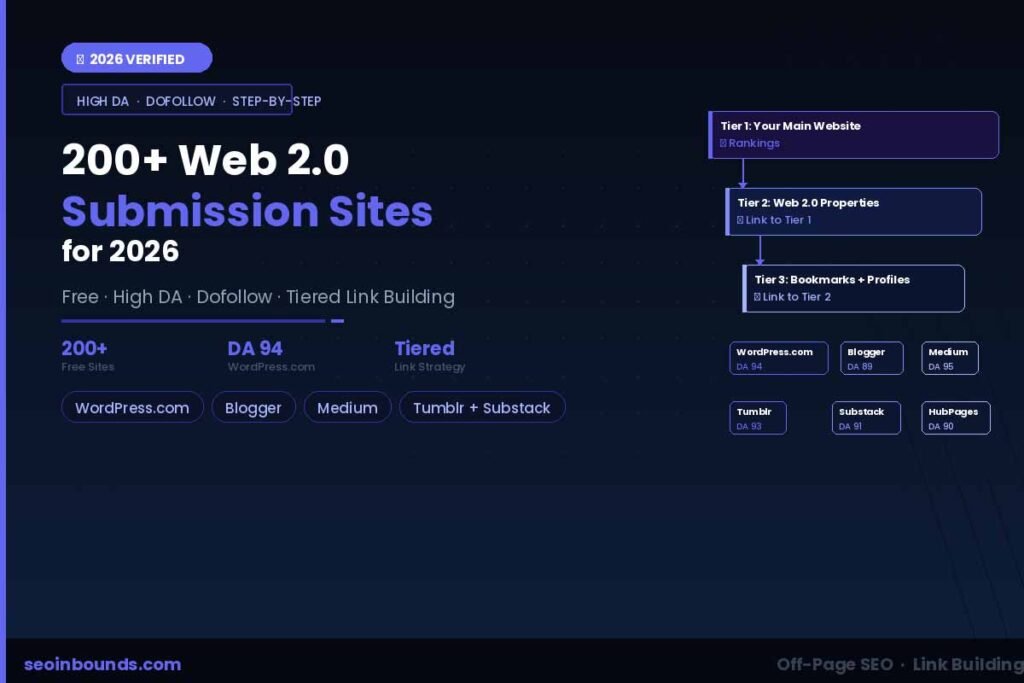
Tiered link building is a strategy where you build links to your links rather than only building links to your main site. Web 2.0 properties are the most common Tier 2 asset used in this approach.
This is the foundation of a solid Web 2.0 SEO strategy 2026, not just placing links anywhere, but using Web 2.0 blogging sites as intentional supporting assets in a structured link architecture.
| Tier | What It Is | Example |
| Tier 1 links | Links pointing directly to your main site | Guest post on Search Engine Journal linking to seoinbounds.com |
| Tier 2 links | Links pointing to your Tier 1 links | Web 2.0 post on WordPress.com linking to your SEJ guest post |
| Tier 3 links | Links pointing to your Tier 2 assets | Social bookmarks pointing to your WordPress.com posts |
The logic: your guest post on SEJ already carries strong link equity. When a Web 2.0 property links to that guest post, it increases the authority of the guest post page, which in turn passes more equity to your main site. You are strengthening links you have already earned.
This approach is legitimate and effective. What makes it risky is using it with low-quality Tier 2 and Tier 3 assets. A network of thin Web 2.0 posts all linking to the same guest post with the same anchor text is a manipulation pattern. Keep Tier 2 content high-quality and varied.
For building the Tier 1 backlinks that Web 2.0 properties support, the free backlink submission sites guide and free guest posting sites guide cover the full platform lists.
Web 2.0 Anchor Text Strategy (The Formula That Avoids Penalties)
Anchor text is where most Web 2.0 link building goes wrong. When every Web 2.0 property links to your site using the exact same keyword-rich anchor, it looks like deliberate manipulation. Google’s Penguin filter is specifically designed to catch this pattern.
| Anchor Type | % of Total Web 2.0 Links | Examples |
| Branded | 30-35% | seoinbounds.com, SEO Inbounds, visit SEO Inbounds |
| Naked URL | 20-25% | https://seoinbounds.com, seoinbounds.com/article |
| Generic phrase | 20-25% | “this guide”, “read more here”, “learn more”, “click here” |
| Partial match keyword | 10-15% | “off-page SEO guide”, “free link building tips” |
| Exact match keyword | 5-10% | “free guest posting sites”, “Web 2.0 submission sites” |
The practical rule: If you have ten Web 2.0 properties all linking to your main site, no more than one of them should use the same exact-match keyword anchor. Vary the anchors deliberately across properties and across time.
Common Web 2.0 Mistakes That Trigger Google Penalties
Web 2.0 link building without getting penalized comes down to avoiding five specific patterns that Google’s spam filters actively target.
1. Creating 50 Properties in One Week
Mass creation of Web 2.0 properties at scale is a manipulation pattern that Google’s algorithms are specifically trained to detect. Build five to ten properties over the first month. Add two to three more per month after that. Natural link profiles grow gradually.
2. Publishing Immediately and Linking Immediately
Creating an account, publishing one thin post, and dropping a backlink on the same day is the textbook spam pattern. Establish the property with three to five content posts before placing any links back to your main site.
3. Using the Same Anchor Text Across All Properties
Ten Web 2.0 properties all linking with the exact phrase “free Web 2.0 submission sites” is a manipulation signal. Follow the anchor text distribution table above and deliberately vary your anchors across every property.
4. Never Updating Properties After Setup
A Web 2.0 blog with one post from six months ago gets de-indexed or loses crawl frequency. Keep each property updated with at least one new post per month. If you cannot maintain it, do not build it.
5. Using Exact Duplicates Across Properties
Publishing the same 600-word article on WordPress.com, Blogger, and Tumblr simultaneously is duplicate content at scale. Write a genuinely different piece for each platform, even if they cover the same general topic.
Never use automated Web 2.0 creation software or services that promise to build hundreds of properties overnight. Google classifies bulk automated link building as manipulative and sites that use these services regularly receive manual penalties. Every Web 2.0 property in this guide should be created and maintained manually.
How Long Before Web 2.0 Backlinks Affect Your Rankings?
| Timeline | What Happens |
| Day 1-3 | Web 2.0 property published. Submit to GSC URL Inspection for fast indexing. |
| Week 1-2 | High-DA properties (WordPress.com, Blogger, Medium) indexed by Google. |
| Week 2-4 | Backlinks appear in Google Search Console Links report. |
| Month 1-2 | Link equity transfer begins. Referral traffic may appear from active platforms. |
| Month 2-4 | Keyword ranking movement for pages linked from Web 2.0 properties. |
| Month 4-6 | Full compound benefit when combined with guest posts, directories, and bookmarking. |
Web 2.0 properties compound best when combined with the full off-page strategy. The social bookmarking sites guide covers how to use bookmarking to accelerate indexing of your Web 2.0 posts, which speeds up the entire timeline.
Frequently Asked Questions
What are Web 2.0 submission sites in SEO?
Web 2.0 submission sites are free publishing platforms where you can create a blog or mini-site on a high-authority domain and publish original content that includes backlinks to your main website. Examples include WordPress.com, Blogger, Medium, and Tumblr. Because these platforms have DA scores between 70 and 98, a link from a well-written article published on them carries significant SEO value.
Do Web 2.0 backlinks still work in 2026?
Yes, when done correctly. Original, well-written content of 600 words or more published on established platforms like WordPress.com or Blogger still delivers real backlink value. What stopped working years ago was thin, automated, duplicate content published on dozens of throwaway accounts at scale. The quality bar is higher in 2026 but the core strategy is still effective for sites that treat Web 2.0 properties as real content assets rather than link vehicles.
Which Web 2.0 sites give dofollow backlinks?
Confirmed dofollow Web 2.0 platforms in May 2026 include WordPress.com (DA 94), Blogger (DA 89), Tumblr (DA 93), Wix.com (DA 93), Weebly (DA 88), Substack (DA 91), Ghost.io (DA 82), HubPages (DA 90), Over-Blog (DA 72), LiveJournal (DA 82), and Typepad (DA 72). Always verify with MozBar on a published post before building a content strategy around any platform.
How many Web 2.0 properties should I build?
Start with five to ten properties on Tier 1 platforms and maintain them properly before expanding. Five well-maintained properties on WordPress.com, Blogger, Tumblr, Substack, and HubPages deliver more SEO value than fifty thin, dormant accounts spread across dozens of platforms. Build slowly, publish consistently, and track which properties send the most referral traffic.
Can Web 2.0 sites get you penalized by Google?
Yes, if used incorrectly. Mass creation of thin Web 2.0 accounts with duplicate or AI-generated content and repeated keyword-stuffed anchor text is a manipulation pattern that Google’s spam filters actively target. Used correctly with original content, natural anchor text variation, gradual build pace, and consistent monthly updates Web 2.0 submission is a completely safe and legitimate off-page SEO strategy.
What is the difference between Web 2.0 sites and article submission sites?
Web 2.0 sites are platforms where you build your own ongoing blog or mini-site and publish content repeatedly over time. Article submission sites are directories where you upload individual articles for distribution. Web 2.0 properties give you more control and stronger link equity because you build a real content presence on a trusted domain. The 200+ free article submission sites guide covers the article directory approach as a complementary tactic.
What content should I publish on Web 2.0 sites?
Original how-to guides, listicles with genuine value, opinion pieces based on real experience, and case studies with actual data. Minimum 600 words. Content should be useful to a reader who found it organically through a search, not just a vehicle for a backlink. Avoid AI-generated content without meaningful human editing, rephrased versions of your own site’s articles, and posts under 400 words with no substantive value.
How do I get my Web 2.0 posts indexed by Google?
Submit the Web 2.0 post URL in Google Search Console’s URL Inspection tool immediately after publishing. Share the post on Twitter/X or LinkedIn to encourage fast crawl discovery. Add a link to the Web 2.0 post from an already-indexed page. The complete URL submission process is covered in the free URL submission to search engines guide.