What Are Dofollow Backlinks
Dofollow backlinks are one of those SEO terms that sound more technical than they really are. A dofollow backlink is simply a normal link from another website to your website that search engines can crawl and treat as a regular editorial link.
In plain English, it is a link that says, “I am linking to this page without adding a nofollow-style label.”
That does not mean every dofollow backlink is powerful. A followed link from a trusted, relevant article can help your SEO. A followed link from a spammy page with no real audience may do very little. In 2026, the question is not only whether a backlink is dofollow. The better question is: does this link come from a page that deserves to recommend you?
This guide explains what dofollow backlinks are, how they differ from nofollow links, why they still matter, how to check them, and how to build them safely as part of a real off-page SEO strategy.
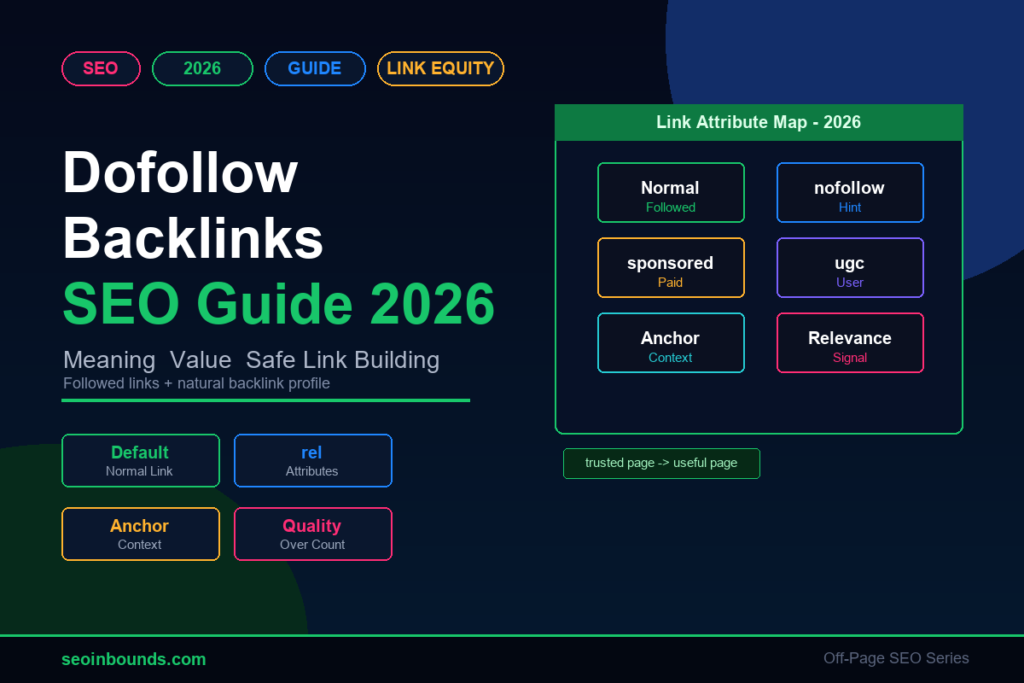
A dofollow backlink is a normal hyperlink from one website to another that does not include rel=”nofollow”, rel=”sponsored”, or rel=”ugc”. Search engines can crawl it and may use it as a ranking signal when the link is relevant, trustworthy, and placed naturally.
Dofollow backlinks matter because they can pass authority, help search engines discover pages, support topical relevance, and bring referral visitors.
Is Dofollow an Actual HTML Tag?
No. This is the first thing to understand. There is no special dofollow tag in normal HTML. SEO people use the word dofollow to describe a link that is followed by default.
A normal followed link looks like this:
<a href=”https://example.com/”>Example website</a>
A nofollow link looks like this:
<a href=”https://example.com/” rel=”nofollow”>Example website</a>
A sponsored link looks like this:
<a href=”https://example.com/” rel=”sponsored”>Example website</a>
So when someone says a link is dofollow, they usually mean the link is a normal crawlable link without a nofollow, sponsored, or UGC attribute.
Dofollow vs Nofollow Backlinks
Dofollow and nofollow backlinks look the same to a normal visitor. The difference is in the HTML code behind the link. Search engines read that code to understand how the linking site wants the link to be treated.
| Link type | HTML signal | Common use | SEO meaning |
| Dofollow | No special rel attribute | Editorial links, trusted references, natural citations | May pass ranking signals |
| Nofollow | rel=”nofollow” | Links you do not fully want to vouch for | Generally not treated like a regular followed endorsement |
| Sponsored | rel=”sponsored” | Ads, paid placements, affiliate links, sponsored posts | Marks a paid or compensated relationship |
| UGC | rel=”ugc” | Comments, forums, user profiles, user-generated posts | Marks user-generated content links |
Google’s documentation explains that regular links do not need a rel attribute. For other relationships, site owners can use sponsored, ugc, or nofollow. Google has also said these attributes are treated as hints, which is why the conversation is more nuanced than a simple yes-or-no switch.
Want to check whether a specific link is dofollow or nofollow? These free backlink checker tools will show you the link type for any backlink pointing to your site.
Why Dofollow Backlinks Matter for SEO
Search engines use links to discover pages and understand relationships between pages. A good backlink can act like a recommendation. It tells search engines that another page found your page useful enough to cite.
Dofollow backlinks can help SEO in four main ways:
- They can pass link equity from a trusted page to the page being linked.
- They can help search engines discover new pages and crawl them more easily.
- They can support topical relevance when the linking page, anchor text, and surrounding content match your topic.
- They can send referral traffic from real readers, not just ranking signals.
The strongest dofollow backlinks usually come from relevant articles, resource pages, local organizations, trusted directories, industry publications, partner pages, and useful content that people naturally want to reference.
What Makes a Dofollow Backlink Valuable?
A dofollow backlink is not automatically good. The quality of the linking page matters more than the label. Before you get excited about a followed link, look at these signals:
| Quality signal | What to check | Why it matters |
| Relevance | Is the linking page about a related topic? | Relevant links give clearer context. |
| Page quality | Is the page helpful, indexed, and readable? | A weak page may pass little value. |
| Traffic potential | Could real users click the link? | Referral visitors are a practical benefit. |
| Anchor text | Is the anchor natural and descriptive? | Over-optimized anchors can look manipulative. |
| Placement | Is the link inside useful content? | Editorial in-content links are usually stronger than footer or sidebar links. |
| Outbound link pattern | Does the page link to many unrelated sites? | Spammy outbound patterns can reduce trust. |
| Indexability | Can Google crawl and index the page? | A blocked or orphaned page may not help much. |
How To Check If a Backlink Is Dofollow
You can check a backlink manually in less than a minute:
- Open the page where the backlink appears.
- Right-click the link and choose Inspect.
- Look for the anchor tag that starts with <a href=.
- Check whether the link contains rel=”nofollow”, rel=”sponsored”, or rel=”ugc”.
- If it has a normal href and no nofollow-style attribute, it is usually a dofollow link.
Example of a followed link:
<a href=”https://seoinbounds.com/free-backlink-submission-sites/”>free backlink submission sites</a>
Example of a nofollow link:
<a href=”https://seoinbounds.com/” rel=”nofollow”>SEO Inbounds</a>
You can also use browser extensions or backlink tools, but manual inspection is useful because tools sometimes miss redirects, JavaScript links, meta robots rules, or page-level issues.
Are Nofollow Backlinks Useless?
No. Nofollow backlinks are not useless. They may not work like normal followed editorial links, but they can still bring traffic, visibility, citations, branded searches, and a more natural backlink profile.
A nofollow link from a popular community, strong publication, or trusted profile page can still put your brand in front of the right people. Some of those people may later link to you from their own websites. That second link might be dofollow, and it started because someone discovered you through a nofollow link.
This is why a natural strategy should include more than one link type. For example, business listing sites, profile creation sites, and social bookmarking sites may not all give clean dofollow links, but they can still support trust, discovery, and brand visibility.
Are Paid Dofollow Backlinks Safe?
This is where many beginners get into trouble. Paid links that are created to pass ranking value can violate Google’s spam policies when they are used to manipulate search rankings. If a link is paid, sponsored, gifted, affiliate-based, or otherwise compensated, it should normally be qualified with rel=”sponsored” or rel=”nofollow”.
That does not mean every paid placement is bad. Advertising, sponsorships, partnerships, and affiliate links can be perfectly legitimate. The issue is pretending a paid link is an unpaid editorial recommendation.
If the only reason a page links to you is because you paid for a followed backlink, treat that as risky. If a page links to you because your content is genuinely useful, relevant, and editorially chosen, that is the kind of dofollow backlink worth earning.
Safe Ways To Earn Dofollow Backlinks in 2026
The safest dofollow backlinks are earned through usefulness, relevance, and relationships. Start with these methods:
- Publish a resource that solves a specific problem better than existing pages.
- Write guest posts for relevant sites that have real editorial standards.
- Create original data, statistics, templates, checklists, or visuals people can cite.
- Build local citations and partner links from real organizations, associations, and suppliers.
- Use digital PR to pitch a useful story, not a generic link request.
- Find unlinked brand mentions and politely ask for the source link.
- Update old content on your site so internal links and external references point to stronger pages.
If you want practical sources to start with, use your existing SEO Inbounds cluster: guest posting sites, free backlink submission sites, Web 2.0 submission sites, article submission sites, and infographic submission sites.
What a Natural Backlink Profile Looks Like
A natural backlink profile is not 100% dofollow with the same keyword anchor repeated everywhere. That pattern looks forced. Real websites attract a mix of links because different platforms handle links differently.
| Profile element | Natural pattern |
| Link attributes | A mix of followed, nofollow, sponsored, UGC, and plain brand mentions |
| Anchor text | Mostly branded, URL, topical, and partial-match anchors |
| Source types | Articles, directories, profiles, communities, resource pages, citations, podcasts, PDFs, and visuals |
| Growth speed | Gradual growth with occasional spikes from campaigns or news |
| Topic fit | Most valuable links come from pages related to your topic or market |
| User value | Good links make sense for real readers, not only crawlers |
Dofollow Backlink Myths
| Myth | Reality |
| Myth: Every dofollow link is good | Truth: A followed link from a weak or spammy page can be ignored or become a liability. |
| Myth: Nofollow links are worthless | Truth: They can still bring referral traffic, brand discovery, and future link opportunities. |
| Myth: Exact-match anchor text is always best | Truth: Too much exact-match anchor text can look unnatural. |
| Myth: More backlinks always means better rankings | Truth: Relevance, quality, and search intent matter more than raw count. |
| Myth: You need paid links to rank | Truth: Paid followed links can be risky. Strong content and real outreach are safer long-term. |
Simple Dofollow Backlink Checklist
- The linking page is indexed or likely to be indexed.
- The page is relevant to your topic, industry, location, or audience.
- The link is placed in useful content, not hidden in a footer or spam block.
- The anchor text reads naturally.
- The page does not link out to dozens of unrelated sites.
- The link was earned or editorially placed, not disguised as a paid endorsement.
- The destination page on your site deserves the link and matches the promise of the anchor text.
30-Day Plan To Build Better Dofollow Backlinks
| Timeline | Action |
| Days 1-3 | Choose one page worth promoting and improve its content, internal links, title, and search intent match. |
| Days 4-7 | Find 20 relevant websites, blogs, directories, partners, or resource pages that would make sense for that page. |
| Days 8-14 | Create one supporting asset: a checklist, infographic, PDF, template, statistic roundup, or short guide. |
| Days 15-21 | Pitch the asset to relevant sites and offer a helpful angle, not a generic backlink request. |
| Days 22-30 | Track replies, live links, link attributes, anchors, referral traffic, and Search Console impressions. |
After publishing this article, submit the URL through your normal indexing process. If needed, follow the steps in free URL submission to search engines.
Final Thoughts
Dofollow backlinks still matter in 2026, but they are not magic. A followed link only becomes valuable when it comes from a page that search engines and people can trust. Relevance, context, anchor text, placement, and real usefulness all matter.
Do not build your whole SEO strategy around chasing the word dofollow. Build pages worth citing, promote them in places where your audience already spends time, and let your backlink profile grow in a way that looks natural because it is natural.
FAQs About Dofollow Backlinks
What are dofollow backlinks?
Dofollow backlinks are normal backlinks that do not use a nofollow, sponsored, or ugc rel attribute. They can be treated as editorial links and may pass ranking signals when the linking page is crawlable, relevant, and trusted.
Is dofollow an actual HTML tag?
No. Dofollow is an SEO term, not a special HTML tag. A normal link is considered followed by default when it uses a crawlable href and does not include rel=”nofollow”, rel=”sponsored”, or rel=”ugc”.
Are dofollow backlinks better than nofollow backlinks?
Dofollow backlinks are usually more valuable for ranking signals, but nofollow links can still bring referral traffic, brand visibility, and a natural backlink profile. A real nofollow link from a trusted website can be more useful than a weak dofollow link from a spammy page.
Do nofollow links pass SEO value in 2026?
Google treats nofollow, sponsored, and ugc as hints rather than simple on/off switches. In practical SEO, you should not rely on nofollow links to pass ranking value, but you also should not ignore them if they send real traffic and brand trust.
How can I check whether a backlink is dofollow?
Open the page, inspect the link in your browser, and check the anchor tag. If the link has a normal href and does not include rel=”nofollow”, rel=”sponsored”, or rel=”ugc”, it is usually treated as a followed link.
Are paid dofollow backlinks safe?
Paid links that pass ranking value can violate Google spam policies when they are created to manipulate rankings. Paid, sponsored, gifted, or affiliate links should be qualified with rel=”sponsored” or rel=”nofollow”.
How many dofollow backlinks do I need to rank?
There is no fixed number. Ranking depends on relevance, search intent, content quality, topical authority, competition, internal links, technical SEO, and backlink quality. One strong relevant link can matter more than dozens of weak ones.
What is a natural dofollow backlink profile?
A natural backlink profile usually includes a mix of followed links, nofollow links, branded anchors, URL anchors, topical anchors, citations, mentions, and links from different relevant websites over time.