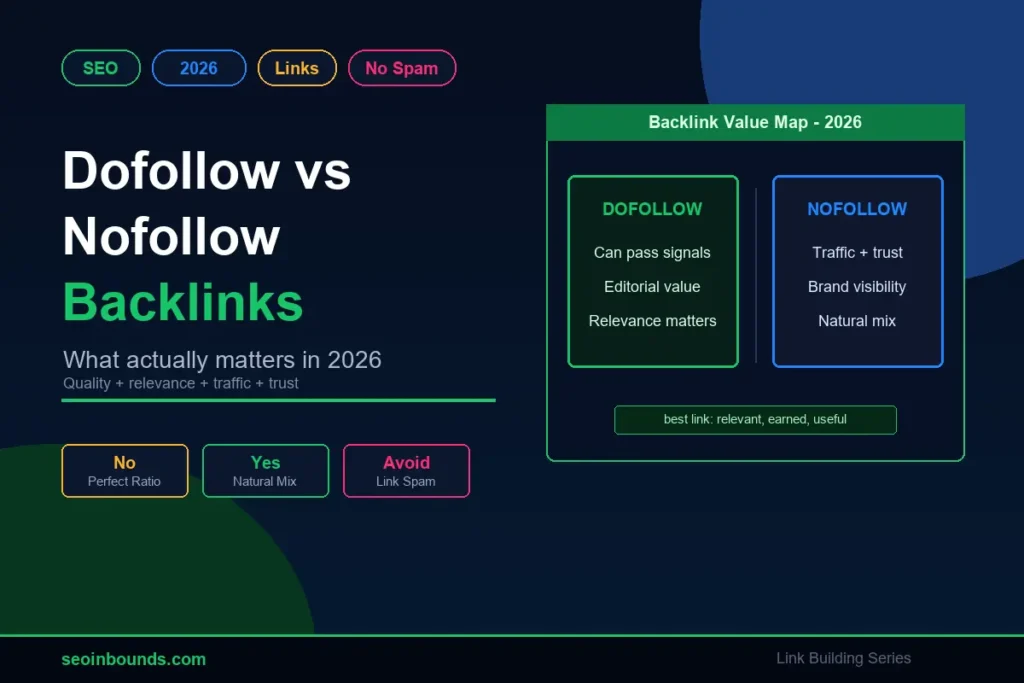
Dofollow vs nofollow backlinks is one of those SEO topics that sounds simple until you start building links for a real website.
One link says, in plain terms, “I trust this page.” The other says, “I am linking, but I am not fully endorsing it in the normal ranking-signal way.” That difference matters.
But in 2026, the smartest SEOs are not asking only, “Is this link dofollow?” They are asking a better question: “Will this link help the site become more trusted, more visible, and more useful to real people?”
That is the angle of this guide. We will keep the technical parts easy, but we will not water down what matters.
You will learn what dofollow backlinks are, what nofollow backlinks mean, how rel sponsored and rel UGC fit in, how to check link attributes, and what kind of backlink profile looks natural. If you need the basic definition first, you can also read what are dofollow backlinks.
A dofollow backlink is a normal backlink that can pass ranking signals. A nofollow backlink uses a link attribute, usually rel=”nofollow”, to tell search engines not to treat the link as a normal endorsement.
Dofollow links are usually more valuable for rankings, but nofollow links are not useless. A nofollow link from a trusted, relevant website can send referral traffic, help people discover your brand, support a natural backlink profile, and sometimes lead to better links later.
So the real answer is this: build useful, relevant backlinks first. Let the dofollow and nofollow mix happen naturally.
A clean link profile with editorial dofollow links, nofollow mentions, branded citations, business profiles, forum links, social links, and content assets is much healthier than a profile made only of exact-match dofollow links.
What Is a Dofollow Backlink?
A dofollow backlink is simply a normal hyperlink without a nofollow, sponsored, or UGC attribute blocking the usual flow of link signals. The word “dofollow” is not normally written in the HTML. It is SEO language for a standard link that search engines can crawl and evaluate as a possible endorsement.
Example of a normal link:
<a href=”https://example.com/”>Example page</a>
If that link is on a relevant page, surrounded by useful context, and placed because the source page genuinely references your work, it can help your SEO. This is why editorial links from strong guides, niche websites, resource pages, research mentions, and real guest posts still matter.
What Is a Nofollow Backlink?
A nofollow backlink is a link with rel=”nofollow” added to the HTML. It tells search engines that the linking site does not want to pass endorsement in the normal way.
<a href=”https://example.com/” rel=”nofollow”>Example page</a>
Nofollow became popular because websites needed a way to link without vouching for everything users or advertisers added. Comments, forums, ads, sponsored mentions, and public profile links created a lot of link spam. Nofollow gave site owners a way to control that.
But here is the part many beginners miss: nofollow does not automatically mean worthless. A nofollow link can still put your brand in front of readers. It can send traffic. It can help people find your page. It can create a citation. It can make your backlink profile look more normal. A huge publication may nofollow its outbound links, but a mention there can still be more valuable than a dofollow link from a directory nobody visits.
Dofollow vs Nofollow Backlinks: Side-by-Side
| Feature | Dofollow Backlinks | Nofollow Backlinks |
| HTML | Normal link without rel nofollow, sponsored, or ugc. | Link includes rel=”nofollow” or similar attribute. |
| SEO signal | Can pass ranking signals when Google trusts the context. | Treated differently and not a normal endorsement. |
| Best use | Editorial links, citations from useful pages, earned mentions, niche resources. | Comments, forums, social platforms, big publications, profiles, paid or untrusted areas. |
| Traffic value | Can send traffic if the page has readers. | Can also send traffic if the page has readers. |
| Risk | Risky when paid, hacked, spammy, irrelevant, or over-optimized. | Lower endorsement risk, but still weak if used as spam. |
| What matters most | Relevance, authority, placement, anchor text, and editorial context. | Relevance, visibility, traffic, brand value, and natural profile balance. |
What About rel Sponsored and rel UGC?
In 2026, the conversation is not only dofollow vs nofollow backlinks. Google also recognizes rel=”sponsored” and rel=”ugc”. These attributes help explain why a link exists.
| Attribute | Meaning | Common Use |
| rel=”nofollow” | The site is not giving a normal endorsement. | Untrusted links, links the site owner does not want to vouch for. |
| rel=”sponsored” | The link exists because of a paid, sponsored, affiliate, or advertising relationship. | Sponsored posts, ads, paid placements, affiliate links. |
| rel=”ugc” | The link was added by users, not the editorial team. | Comments, forums, community posts, user profiles. |
If you publish sponsored content or accept user submissions, using the right attribute matters. It keeps your site cleaner and helps avoid the kind of link practices covered in Google’s spam policies.
Which Backlinks Matter Most in 2026?
The best backlinks in 2026 have four things in common: relevance, trust, context, and a reason to exist. A dofollow link from an unrelated page with a stuffed anchor is not better than a nofollow link from a respected site that sends qualified visitors. Search engines are better at understanding patterns now. They can see when a link profile is built for users and when it is built for shortcuts.
A good link usually answers these questions:
- Is the linking page related to your topic or industry?
- Would a real reader reasonably click this link?
- Is the anchor text natural?
- Is the link placed inside helpful content instead of a random footer or link list?
- Does the site have a real audience?
- Would you still want the mention if the link were nofollow?
That last question is powerful. If you would only want the link because it is dofollow, the link may not be as good as it looks.
Are Nofollow Backlinks Good for SEO?
Yes, when they come from the right places. Nofollow backlinks can help with discovery, referral traffic, brand authority, and natural link diversity. They can also lead to dofollow links indirectly. Someone might find your brand through a nofollow link on a forum, social site, press mention, or big publication, then cite your guide later from their own blog.
This is why nofollow links from forum posting sites, social bookmarking sites, business listing sites, and free press release submission sites should not be dismissed. Some will not pass traditional link value, but they can still help your content move through the web.
Are Dofollow Backlinks Always Better?
No. Dofollow links are usually the links SEOs want most, but they are not automatically safe. A dofollow link from a hacked site, private blog network, low-quality directory, spun article page, or irrelevant foreign-language link farm can do more harm than good. A dofollow link is powerful only when the source and context are trustworthy.
This is where many backlink campaigns go wrong. They filter opportunities by link attribute first and quality second. Flip that. Filter by relevance, page quality, audience, and placement first. Then look at the attribute.
The Natural Backlink Mix: What Looks Normal?
There is no perfect dofollow to nofollow ratio. A local service business, SaaS company, affiliate blog, ecommerce site, and SEO agency will all attract different link patterns. A healthy backlink profile usually has a mix of:
- Editorial dofollow links from useful content.
- Nofollow links from forums, social sites, communities, and large publications.
- Branded citations from business listings and profiles.
- Naked URL links from resource pages or directories.
- Image, PDF, video, and infographic links from content assets.
- A small number of natural keyword-rich anchors, not a flood of exact-match anchors.
If every backlink uses the same keyword anchor and every link is dofollow, that does not look natural. It looks engineered. A real brand collects messy, varied, human-looking links.
How to Check If a Backlink Is Dofollow or Nofollow
You do not need to be a developer to check a link. Open the page, right-click the link, choose Inspect, and look for the rel attribute in the HTML. If you see rel=”nofollow”, rel=”sponsored”, or rel=”ugc”, the link is not a standard dofollow link. If you do not see those attributes, it is usually treated as a normal link.
For bigger checks, use a backlink checker, browser extension, SEO crawler, or site audit tool. The live keyword data showed people searching for dofollow backlinks checker and dofollow and nofollow backlinks checker, so a short practical workflow helps:
- Export your backlinks from your SEO tool or Search Console data.
- Check the source page, anchor text, and link attribute.
- Mark each link as dofollow, nofollow, sponsored, UGC, or unknown.
- Review relevance and placement, not only the attribute.
- Watch for repeated exact-match anchors and suspicious source sites.
Where Dofollow Links Usually Come From
Good dofollow backlinks often come from editorial places: guest posts, resource pages, original research, useful tools, niche blogs, expert quotes, case studies, data mentions, and genuine citations. If you are building from zero, start with a simple plan from how to build backlinks for free and keep your submissions organized with the off-page SEO checklist.
You can also use selected free backlink submission sites and free SEO submission sites for foundation work, but do not confuse foundation links with authority links. They help create a footprint. They are not a replacement for earned editorial links.
Where Nofollow Links Usually Come From
Nofollow links often come from platforms where users can add links: forums, comments, profile pages, press release platforms, social platforms, bookmarking sites, and large editorial websites that nofollow most outbound links by policy. These links can still be useful when the audience is real.
For example, a helpful answer on a forum might use a UGC or nofollow link. It may not pass link value like a normal editorial link, but if it solves a real problem and sends visitors to your guide, it is still doing SEO-adjacent work: building visibility, trust, and demand.
How Anchor Text Changes the Risk
Anchor text is the clickable text of a link. It helps search engines understand context, but it can become risky when overused. If you build 100 links and 80 of them use the exact same keyword, that looks unnatural. Natural backlink profiles include branded anchors, naked URLs, page titles, partial-match phrases, and generic anchors.
| Anchor Type | Example | Use |
| Brand | SEO Inbounds | Very safe and natural for most link profiles. |
| Naked URL | https://seoinbounds.com/ | Common in citations, profiles, and directories. |
| Page title | Dofollow vs Nofollow Backlinks | Natural when referencing the article. |
| Partial match | guide to nofollow backlinks | Useful in moderation. |
| Exact match | dofollow vs nofollow backlinks | Use carefully and naturally. |
| Generic | read this guide | Normal when the context around the link is clear. |
A Simple Link Building Rule for 2026
Here is the rule I would use for almost every site: earn dofollow links, accept useful nofollow links, avoid manipulative links, and track everything. You do not need every link to pass PageRank to be worth having. You do need every link to make sense.
If a link sends qualified visitors, introduces your brand to the right audience, supports a citation, helps people discover your content, or creates a real relationship, it has value. If a link exists only because a tool blasted your URL into a dead page, it probably does not.
30-Day Plan to Build a Natural Mix
| Week | Action | Goal |
| Week 1 | Audit existing backlinks, classify dofollow, nofollow, sponsored, and UGC links. | Understand your current link profile. |
| Week 2 | Build clean citations, profiles, and business listings with branded anchors. | Create trust and entity signals. |
| Week 3 | Pitch guest posts, resource links, and useful mentions in your niche. | Earn relevant editorial dofollow links. |
| Week 4 | Answer forum questions, share assets, submit PDFs or infographics, and monitor referral traffic. | Add natural nofollow and discovery links. |
This plan pairs well with free directory submission sites, free profile creation sites, PDF submission sites, and infographic submission sites. The point is not to build every link type at once. The point is to create a balanced footprint over time.
Mistakes to Avoid
- Ignoring nofollow links completely.
- Chasing dofollow links from irrelevant or spammy sites.
- Using the same exact-match anchor text everywhere.
- Buying links without proper sponsored attributes.
- Confusing traffic value with link attribute value.
- Submitting to every directory or profile site without quality checks.
- Building links to weak pages that do not deserve to rank.
- Forgetting internal links before starting off-page work.
Final Verdict
Dofollow backlinks usually carry more direct SEO value, but nofollow backlinks still matter when they bring visibility, trust, traffic, and a natural link profile. The best SEO strategy in 2026 is not dofollow only. It is quality first, relevance second, natural anchors third, and link attribute fourth.
If you remember one thing from this guide, make it this: a backlink is only as good as the page, audience, context, and reason behind it. A strong nofollow mention can help your brand more than a weak dofollow link. A strong dofollow editorial link can move rankings more than almost any basic submission. You need both types in the right places.
FAQs
What is the difference between dofollow and nofollow backlinks?
A dofollow backlink is a normal link that can pass ranking signals. A nofollow backlink uses rel=”nofollow” and tells search engines that the site does not want to endorse the linked page in the normal way. In 2026, both can still matter, but they matter for different reasons.
Are nofollow backlinks useless for SEO?
No. Nofollow backlinks may not pass value like normal editorial links, but they can still bring referral traffic, brand visibility, crawl discovery, and a more natural backlink profile. A nofollow link from a trusted website can be more useful than a weak dofollow link from a spammy page.
Are dofollow backlinks always better?
No. A relevant editorial dofollow link is valuable, but a dofollow link from a link farm, hacked page, private blog network, or irrelevant directory can create risk. Quality, relevance, and context matter more than the label alone.
What is rel sponsored?
rel=”sponsored” is used for paid links, sponsorships, affiliate links, and advertising-style links. It helps search engines understand that the link was created because of a commercial relationship.
What is rel UGC?
rel=”ugc” is used for user-generated content links, such as comments, forum posts, and community submissions. It helps separate editorial links from links added by users.
What backlink ratio should I use in 2026?
There is no perfect dofollow to nofollow ratio. A natural backlink profile usually has a mix of normal links, nofollow links, branded links, naked URLs, citations, and mentions. Focus on relevance and quality instead of chasing a fixed percentage.
How do I check if a backlink is dofollow or nofollow?
Open the page, inspect the link in your browser, and look for rel=”nofollow”, rel=”sponsored”, or rel=”ugc”. You can also use backlink tools, browser extensions, or SEO crawlers to check link attributes at scale.
Should I build nofollow links intentionally?
Yes, when the link can bring traffic, trust, or visibility. Forums, social sites, business listings, press releases, and big publications often use nofollow or UGC attributes, but they can still support your brand and content promotion.