Off-page SEO checklist work can get messy fast. One day you are building backlinks, the next day you are creating profiles, submitting business listings, answering forum questions, chasing guest posts, and wondering whether any of it is actually helping.
That is why a checklist helps. Not the kind that says ‘build links’ and leaves you guessing. A useful off-page SEO checklist tells you what to do first, what to repeat every month, what to avoid, and how each task supports authority, trust, referral traffic, and rankings in 2026.
This guide is the free version that works. It ties together backlinks, citations, profiles, forums, guest posts, content promotion, and tracking into one practical off-page SEO workflow.
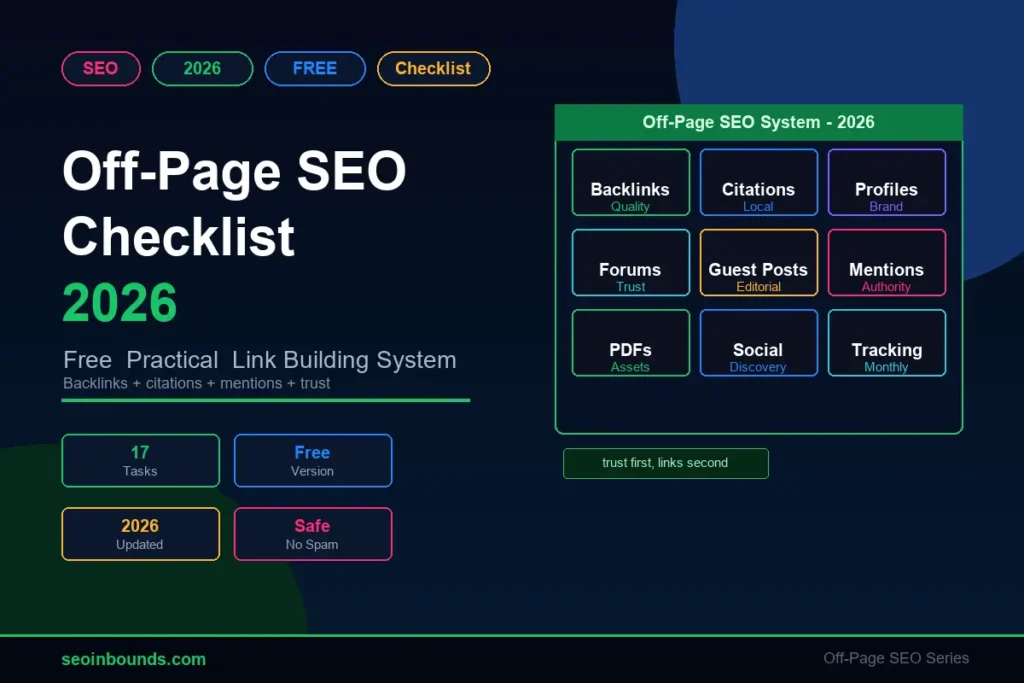
A strong off-page SEO checklist in 2026 should include backlink building, profile creation, business listings, local citations, guest posting, forum posting, social bookmarking, content repurposing, PDF and infographic submissions, brand mentions, reviews, backlink monitoring, and monthly performance tracking. The goal is not just more links; it is more trust from the right places.
Download the Printable Off-Page SEO Checklist (2026)
Prefer a checklist you can check off directly, print, or drop into Notion/Google Sheets? Use the version below, it’s the same system explained in this guide, condensed into a straightforward task list.
1. Foundation (Do These First)
- Audit your current backlink profile (Search Console → Links, or Ahrefs free tier)
- Identify and disavow toxic/spam backlinks if any exist
- Set up a link-tracking spreadsheet (Platform, DA, URL, Anchor Text, Date, Indexed Y/N)
- Claim your Google Business Profile (if local business)
- Set up consistent NAP (Name, Address, Phone) across all citations
2. Link Building | Web 2.0 & Publishing
- Create profiles on 3-5 high-DA Web 2.0 platforms (Blogger, WordPress.com, Tumblr, Medium)
- Publish 3+ original posts (600+ words) before adding backlinks
- Vary anchor text across each platform (branded/generic/exact-match mix)
- Link back to your site naturally within content, not just in a bio
3. Link Building | Directories & Listings
- Submit to 5-10 niche-relevant business/article directories
- Submit to general high-DA directories (Crunchbase, Yelp, etc.)
- Verify each listing is live and indexed within 2-4 weeks
4. Guest Posting & Outreach
- Build a target list of 10-20 sites in your niche accepting guest posts
- Draft a personalized outreach pitch (not a template blast)
- Track pitches sent, responses, and published posts
- Include 1-2 contextual backlinks per accepted guest post
5. Social & Community Signals
- Share new content across relevant social platforms
- Participate in 2-3 niche forums or Q&A sites (Quora, Reddit, Stack Exchange)
- Answer questions genuinely, link only when directly relevant
- Set up/maintain a presence on 1-2 social bookmarking sites
6. Digital PR & Brand Mentions
- Set up Google Alerts for your brand name
- Reach out to sites that mention your brand without linking, ask for a link
- Look for “resource page” link opportunities in your niche
- Consider one data-driven or original-research piece designed for outreach/links
7. Local SEO (if applicable)
- List business on major local directories (Yelp, Yellow Pages, industry-specific)
- Keep NAP consistent everywhere
- Collect and respond to reviews on Google Business Profile
8. Monitoring & Maintenance (Ongoing, Monthly)
- Check Search Console Links report for new/lost backlinks
- Re-verify indexing status of key backlink pages
- Track ranking movement for target keywords
- Add 8-12 new backlinks per month, paced — not in a single burst
- Review anchor text distribution (aim for 80% branded/generic, 20% exact-match)
[Download as PDF] [Download as Excel]
For a second opinion beyond Search Console, these free backlink checker tools let you cross-check your link profile and spot anything Google hasn’t picked up yet.
What Is an Off-Page SEO Checklist?
An off-page SEO checklist is a repeatable list of tasks you do outside your website to improve how search engines and users see your brand. It covers backlinks, mentions, citations, reviews, profiles, social visibility, PR, community participation, and reputation.
Read Guide for Discovered vs crawled – Currently not indexed.
On-page SEO improves what is on your website. Off-page SEO improves what the rest of the web says about your website. You need both, but this article focuses only on the off-site side.
The Free Off-Page SEO Checklist for 2026
Use this checklist as a working system. Some tasks are one-time setup items. Others should be repeated monthly.
| # | Task | What to do | Frequency |
| 1 | Choose one target page | Pick a page that deserves links before doing any off-page work. | One time |
| 2 | Fix internal links first | Link to the target page from relevant pages on your own site. | One time |
| 3 | Submit the URL for discovery | Use Google/Bing submission where appropriate after publishing. | One time |
| 4 | Build a clean brand profile | Create consistent brand, author, and company profiles. | One time |
| 5 | Create business listings | Add accurate NAP details on relevant local citation sites. | One time/quarterly |
| 6 | Claim niche profiles | Use relevant profile creation sites, not every platform available. | Monthly |
| 7 | Build foundational backlinks | Use safe submission, profile, and resource opportunities. | Monthly |
| 8 | Use guest posting selectively | Pitch useful topics to relevant websites with real audiences. | Monthly |
| 9 | Join forum discussions | Answer real questions and link only when the link helps. | Weekly |
| 10 | Repurpose into PDFs | Create a checklist, worksheet, or guide and submit it properly. | Monthly |
| 11 | Create visual assets | Turn useful ideas into images, infographics, or short videos. | Monthly |
| 12 | Share on social/bookmarking sites | Use social bookmarking for discovery, not link spam. | Weekly |
| 13 | Earn brand mentions | Pitch quotes, tools, data, or examples people can cite. | Monthly |
| 14 | Monitor backlink quality | Check new links, anchors, relevance, and referral traffic. | Monthly |
| 15 | Avoid link spam | Skip generators, PBNs, hacked links, and exact-match anchor blasts. | Always |
| 16 | Track every action | Use a simple sheet with source, URL, status, anchor, and notes. | Always |
| 17 | Review results | Look at Search Console impressions, rankings, referral traffic, and leads. | Monthly |
1. Choose One Page Worth Promoting
Before you build a single link, choose the page you want to promote. Do not send off-page signals to a weak article just because it exists. Improve the page first.
- The page matches search intent.
- The content is useful enough to cite.
- The title and H1 are clear.
- The page has internal links from related articles.
- The page offers something worth sharing: a guide, checklist, template, data point, visual, or strong explanation.
For a free backlink campaign, use your how to build backlinks for free guide as the action plan.
2. Build a Natural Backlink Foundation
Backlinks still matter, but the quality of the link matters more than the raw count. One relevant link from a trusted page is better than dozens of links from random places nobody reads.
Start by understanding what are dofollow backlinks, then use free backlink submission sites carefully. Dofollow is nice, but relevance and trust come first.
A natural backlink foundation usually includes:
- Branded profile links.
- Relevant directory or citation links.
- A few editorial links from guest posts or resource pages.
- Nofollow links from real communities.
- Mentions from social platforms, forums, and content-sharing sites.
- A mix of branded, URL, topical, and partial-match anchor text.
3. Create Brand Profiles and Citations
Profiles and citations are not glamorous, but they make your brand look real. They are especially useful for new websites, local businesses, and service brands.
Use profile creation sites for brand and author profiles, then add accurate details on business listing sites and directory submission sites. Keep your name, address, phone, logo, and website consistent.
4. Use Guest Posting the Right Way
Guest posting still works when the article is written for the audience, not just for a backlink. A good guest post should feel like it belongs on that website.
- Pitch topics that match the site’s readers.
- Avoid recycled articles with swapped introductions.
- Use natural author bio links.
- Link to your page only when it supports the article.
- Do not use exact-match anchors everywhere.
Start with relevant guest posting sites, but be selective. A real audience matters more than a big list.
5. Join Forums and Communities Without Spamming
Forums are useful because they show you how real people talk about problems. They can also send referral traffic when your answer is genuinely helpful.
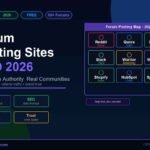
Use forum posting sites to answer questions, learn pain points, and share resources carefully. Think help first, link second.
Reddit and Quora deserve special attention here since they carry far more search visibility than a typical forum, our Reddit SEO and Quora SEO guide covers the self-promotion rules and subreddit-specific tactics that make the difference between getting banned and building real visibility.
6. Repurpose Content Into Shareable Assets
One good article can become a PDF, infographic, image, video, checklist, or slide. This gives you more natural places to promote the same idea without copying the same content everywhere.
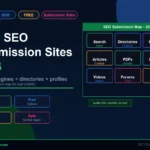
For distribution, use PDF submission sites, infographic submission sites, image submission sites, and video submission sites. Write a fresh description for every important submission.
7. Use Web 2.0, Article, and Social Bookmarking Sites Carefully
These platforms can help discovery, but they are easy to misuse. Do not copy and paste your full article onto every platform. Write a short supporting version, add a new angle, and link back naturally.
Use Web 2.0 submission sites, article submission sites, and social bookmarking sites as supporting channels, not as a replacement for good content.
8. Build Brand Mentions and PR Signals
Off-page SEO is not only about backlinks. Brand mentions matter because they help people and search engines connect your name with a topic. Some mentions link. Some do not. Both can still support visibility.
If you have news, data, a launch, or a strong announcement, use press release submission sites carefully. Do not publish press releases for ordinary blog posts. Use them when there is a real story.
9. Track Links, Mentions, and Results
The easiest way to waste time on off-page SEO is to do work without tracking it. You do not need a fancy dashboard at first. A spreadsheet is enough.
Date | Task | Source | Target URL | Anchor | Status | Live URL | Link type | Indexed | Referral traffic | Notes
| Metric | Why it matters |
| Live links | Shows which submissions, pitches, and profiles actually went live. |
| Link type | Helps you understand dofollow, nofollow, sponsored, and UGC mix. |
| Anchor text | Keeps your backlink profile natural. |
| Referral traffic | Shows whether real people clicked. |
| Search Console impressions | Shows whether visibility is improving. |
| Mentions | Tracks brand visibility even when there is no link. |
Monthly Off-Page SEO Routine
A checklist only works if you repeat the right parts. Here is a simple monthly routine.
| Week | Focus | Actions |
| Week 1 | Audit and planning | Check backlinks, anchors, mentions, rankings, and target pages. |
| Week 2 | Foundational links | Update profiles, citations, directories, and business listings. |
| Week 3 | Content promotion | Repurpose one asset into PDF, visual, social, or Web 2.0 formats. |
| Week 4 | Outreach and communities | Pitch guest posts, answer forum questions, follow up, and track results. |
Off-Page SEO Mistakes To Avoid
| Mistake | Better approach |
| Chasing link count only | Build links that make sense for users and the topic. |
| Using automated backlink generators | These usually create weak, irrelevant, or risky links. |
| Repeating exact-match anchor text | Use branded, URL, and natural anchors. |
| Ignoring nofollow links | Nofollow links can still send traffic and brand discovery. |
| Submitting everywhere | Relevance beats volume. |
| Forgetting internal links | Internal links help your promoted pages receive and distribute value. |
| Never checking results | Track what went live and what sent traffic. |
Final Thoughts
An off-page SEO checklist should not feel like a pile of random tasks. It should feel like a system: build trust, earn visibility, create useful assets, participate where your audience spends time, and track what actually moves the needle.
In 2026, the free version still works if you do it patiently. You do not need every backlink on the internet. You need the right signals from the right places, pointing to pages that deserve attention.
FAQs About Off-Page SEO Checklist
What is an off-page SEO checklist?
An off-page SEO checklist is a step-by-step list of tasks you do outside your website to build trust, authority, visibility, backlinks, mentions, citations, and referral traffic.
Is off-page SEO still important in 2026?
Yes. Off-page SEO still matters in 2026, but it is less about quick link tricks and more about trust, relevance, brand mentions, quality backlinks, local citations, reviews, and real visibility across the web.
What should be included in an off-page SEO checklist?
A good checklist should include backlink building, competitor link research, brand mentions, profile creation, business listings, local citations, guest posting, forums, social sharing, content repurposing, review building, and link quality monitoring.
How often should I do off-page SEO?
Some tasks are one-time setup tasks, such as profiles and citations. Others should be done monthly, such as outreach, content promotion, backlink monitoring, and refreshing your opportunity list.
Are backlinks the only part of off-page SEO?
No. Backlinks are important, but off-page SEO also includes brand reputation, reviews, local citations, unlinked mentions, social visibility, community participation, PR, and referral traffic.
Can I do off-page SEO for free?
Yes. You can start with free profiles, business listings, forum participation, guest post outreach, PDF and infographic submissions, social bookmarking, and helpful community answers.
What off-page SEO tactics should I avoid?
Avoid automated backlink generators, link farms, private blog networks, hacked links, paid links disguised as editorial links, irrelevant directories, and repeated exact-match anchor text.
Should I make an off-page SEO checklist PDF or Excel file?
Yes, a PDF or Excel version is useful for tracking. A spreadsheet works best for ongoing work because you can track source, URL, status, anchor text, link attribute, referral traffic, and notes.