
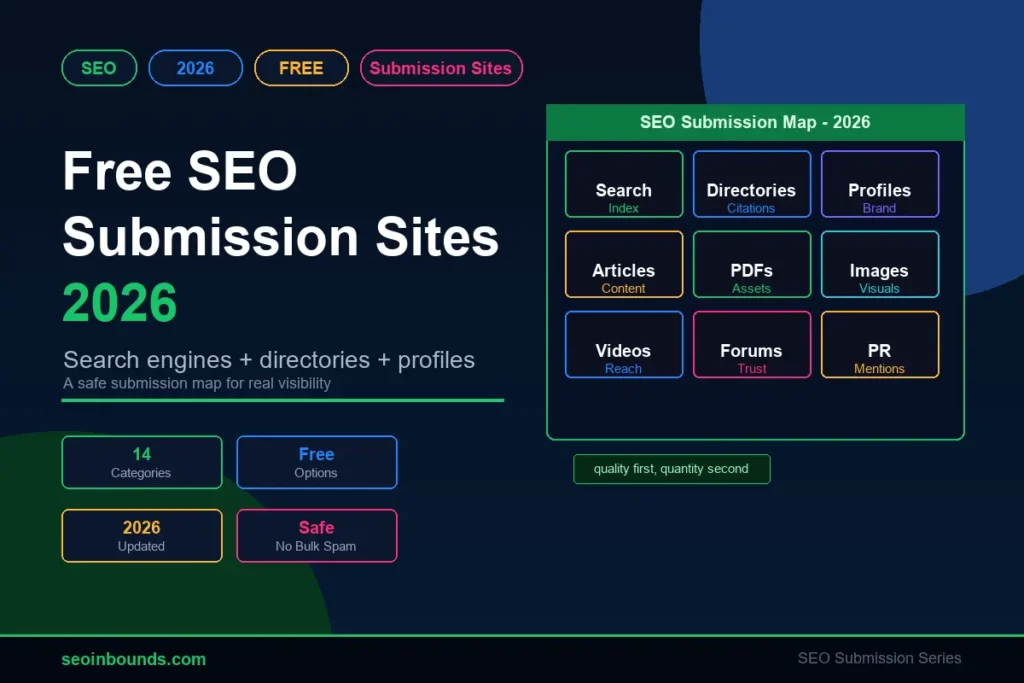
Free SEO submission sites can still help in 2026, but only if you treat them like a visibility system, not a shortcut. The old idea was simple: submit your link everywhere and hope something sticks. That is exactly the kind of thinking that creates weak backlinks, messy profiles, and zero real traffic. A better approach is calmer: choose the right platforms, write useful descriptions, keep your brand consistent, and connect every submission back to a page that deserves attention.
This guide gives you a practical way to use free SEO submission sites without making your backlink profile look forced. It also connects the bigger pieces of off-page SEO, so if you need a deeper workflow you can pair this with the off-page SEO checklist and the guide on how to build backlinks for free.
The best free SEO submission sites in 2026 are not one single list. They are a mix of search engine submission tools, directory submission sites, business listing sites, profile creation platforms, article submission sites, PDF submission sites, image and video platforms, infographic galleries, social bookmarking sites, forums, guest posting opportunities, and press release submission sites. Used together, they help with indexing, brand discovery, citations, referral traffic, and safe backlink building.
What Are Free SEO Submission Sites?
Free SEO submission sites are places where you can submit some part of your online presence without paying: a homepage, blog post, sitemap, business profile, author profile, PDF, infographic, image, video, press release, or helpful article. Some create a backlink. Some create a nofollow link. Some create a citation. Some simply help people discover your brand. That mix is useful because modern off-page SEO is not only about chasing dofollow backlinks.
If you are still unsure how this fits into the bigger picture, start with what is off-page SEO. The short version: submissions are a foundation. They should support trust, relevance, and visibility. They should not replace good content, internal linking, technical SEO, or real outreach.
Free SEO Submission Sites List by Category
| Category | Examples / Site Types | Best For | 2026 Use Tip |
| Search engine submission | Google Search Console, Bing Webmaster Tools, IndexNow | Indexing and crawl discovery | Submit sitemap, inspect key URLs, avoid repeated resubmission. |
| Directory submission sites | Niche directories, SaaS directories, startup directories | Foundational citations and discovery | Use only relevant directories with real pages and moderation. |
| Business listing sites | Google Business Profile, Bing Places, Yelp, Apple Business Connect | Local SEO, NAP consistency, brand trust | Keep name, address, phone, categories, and website consistent. |
| Profile submission sites | Crunchbase, About.me, LinkedIn, GitHub, Behance | Brand/entity signals and referral traffic | Complete the profile; do not create empty link-only pages. |
| Article submission sites | Medium, Substack, HubPages, niche publishing platforms | Useful content distribution | Publish original summaries, not duplicate full articles. |
| Web 2.0 submission sites | Medium, WordPress.com, Blogger, Tumblr, Hashnode | Supporting content and topical coverage | Build helpful mini-assets instead of thin doorway pages. |
| PDF submission sites | Scribd, Issuu, Slideshare-style document platforms | Checklists, worksheets, guides, and resource assets | Upload genuinely useful PDFs with branded context. |
| Image submission sites | Pinterest, Flickr, Behance, Dribbble-style platforms | Visual discovery and image SEO | Use descriptive titles, alt text, and source-page links. |
| Video submission sites | YouTube, Vimeo, Dailymotion-style platforms | Video discovery and brand visibility | Add descriptions, chapters, and a natural page link. |
| Infographic submission sites | Visual.ly-style galleries, design communities, niche blogs | Visual backlinks and shares | Submit one strong infographic with a short unique description. |
| Social bookmarking sites | Flipboard, Scoop.it, Reddit-style communities | Discovery and engagement | Share selectively; do not dump every URL everywhere. |
| Forum posting sites | Niche forums, support communities, Q&A communities | Trust, traffic, and topical conversations | Answer first, link only when it helps the reader. |
| Guest posting sites | Niche blogs and editorial websites | Editorial links and authority | Pitch useful topics and avoid paid/link-farm networks. |
| Press release submission sites | OpenPR, PRLog, industry news sites | News discovery and brand mentions | Use only for real news, launches, data, or announcements. |
1. Start With Search Engine Submission
Before you chase backlinks, make sure search engines can actually discover your content. Search engine submission is the cleanest starting point for a new or updated page. Use Google Search Console to inspect important URLs and submit your sitemap. Use Bing Webmaster Tools for sitemap submission and URL submission. If your setup supports IndexNow, use it for fast crawl notifications on supported search engines.
For a step-by-step version, use SEO Inbounds’ guide to free URL submission to search engines. This is not the same as ranking. Submission helps discovery; ranking still depends on quality, relevance, authority, and user satisfaction.
2. Use Directory Submission Sites Carefully
Directory submission sites are still useful when they are relevant, moderated, and searchable. A real directory has categories, real listings, editorial standards, and users who might actually browse it. A weak directory has thousands of random outbound links, thin pages, and no obvious audience.
If your site is local, niche, SaaS, startup, professional, or service-based, use a small set of good directories. Do not submit to every directory you can find. A tighter list of free directory submission sites is better than a spreadsheet full of low-quality pages.
You can expand this section through the dedicated free directory submission sites article.
3. Build Business Listings and Citations
Business listing sites are especially important for local SEO. They help search engines and customers confirm that your business is real. Your name, address, phone number, website, categories, hours, and description should stay consistent across listings. Even if a listing uses a nofollow link, the citation can still support trust and discovery.
Good business listings are not link dumps. Add photos, services, social profiles, a clean description, and your correct website URL. The full list can sit under your business listing sites page.
4. Create Strong Profile Submissions
Google Suggest showed interest around free profile submission sites for SEO, which makes sense. Profiles are one of the easiest ways to create a clean brand footprint. The mistake is creating empty profiles just to place a URL. That looks thin. A useful profile has a real bio, logo, social links, industry details, and a reason for someone to click through.
Use profile creation for entity building and referral traffic. If the profile is relevant to your niche, complete it properly. If it has no audience and no context, skip it. For more options, connect readers to free profile creation sites.
5. Add Free Backlink Submission Sites, But Do Not Overdo It
Free backlink submission sites are popular because the promise is simple: submit a link and get a backlink. Some are useful. Many are not. The safe way is to filter every site before using it. Ask whether the site is indexed, moderated, relevant, active, and useful to a real person. If the answer is no, the link probably is not worth your time.
This is where anchor text matters. Do not use the same exact-match anchor again and again. Mix your brand name, naked URL, page title, and natural phrases. If you want a dedicated list, use the free backlink submission sites page and keep this article as the main hub.
6. Publish Supporting Content on Article and Web 2.0 Sites
Article submission sites and Web 2.0 submission sites can help when you use them for supporting content, not duplicate content. Do not copy your full blog post onto ten platforms. Write a short original version, a checklist, a summary, a case example, or a related angle that naturally points back to the main page.
For example, if your main post is about free SEO submission sites, a supporting Web 2.0 post could explain how beginners should choose the first ten platforms. That is useful, different, and connected. You can link this section to free article submission sites and Web 2.0 submission sites.
7. Repurpose the Article Into PDFs, Images, Videos, and Infographics
One strong article can become several useful assets. Turn your main checklist into a PDF. Turn the categories into an infographic. Turn the submission workflow into a short video. Turn the key tips into images. This gives you more ways to submit your content without repeating the same URL in the same format.
This is a natural place to use PDF submission sites, image submission sites, video submission sites, and infographic submission sites. Keep each upload useful on its own. A PDF should have a title, intro, checklist, branded footer, and source link. A video should have a description and chapters. An infographic should have a short summary that is not copied from the article.
8. Use Social Bookmarking, Forums, and Communities for Discovery
Social bookmarking sites and forums can bring discovery, but they punish lazy promotion fast. Share only when the page fits the community. If someone asks how to submit a website for free, your answer can mention search engine submission, directories, profiles, and a relevant resource. If you drop a link with no context, it will look promotional because it is promotional.
Use the dedicated pages for social bookmarking sites and forum posting sites when you want more platform ideas.
9. Add Guest Posts and Press Releases When They Make Sense
Guest posting sites and press release submission sites are not basic form submissions, but they belong in a complete SEO submission strategy. Guest posts work when the site has a real audience and your topic helps that audience. Press releases work when you have real news: a launch, report, partnership, event, data study, or important update.
Use free guest posting sites for editorial opportunities and free press release submission sites for news-style visibility. Do not turn either one into a link scheme.
Safe Submission Rules for 2026
- Submit to fewer sites, but make each submission complete and useful.
- Use your brand name often; do not force exact-match anchors everywhere.
- Write unique descriptions for important platforms.
- Keep NAP details consistent on business listing sites.
- Use nofollow, sponsored, or UGC links where appropriate.
- Avoid automated bulk submission tools and link farms.
- Track every submission in a spreadsheet.
- Check whether each submitted page gets indexed and sends referral traffic.
A Simple 30-Day Submission Plan
| Week | What To Do | Target |
| Week 1 | Submit sitemap, inspect important URLs, set up Bing Webmaster Tools, and fix crawl issues. | Search engine submission |
| Week 2 | Create or update business listings, citations, and brand profiles. | Trust and entity building |
| Week 3 | Submit to selected directories, article platforms, PDF sites, image sites, and Web 2.0 platforms. | Foundational visibility |
| Week 4 | Share useful assets in communities, answer forum questions, pitch guest posts, and monitor results. | Referral traffic and quality links |
What To Track After Submission
Do not finish the work and disappear. Track source URL, submitted page, anchor text, link type, approval status, indexed status, referral traffic, and notes. A simple sheet will show which free SEO submission sites actually help and which ones only waste time.
If a platform sends no traffic, never gets indexed, and has no relevance, stop using it. If a platform sends referral visits or helps build a clean brand profile, keep it in your rotation.
Common Mistakes To Avoid
- Submitting the same description to every site.
- Using only exact-match anchor text like free SEO submission sites.
- Submitting to irrelevant directories just because they are free.
- Creating empty profiles with nothing but a backlink.
- Uploading duplicate PDFs, images, or articles with no unique value.
- Confusing submission with ranking. Submission helps discovery; ranking takes quality and authority.
- Ignoring Google spam policies and treating every platform like a link machine.
Final Thoughts
Free SEO submission sites are useful when they are part of a real off-page SEO system. Start with search engine submission, build clean business listings and profiles, add relevant directories, repurpose your best content into useful assets, and use communities with patience. That is slower than bulk submission, but it creates a cleaner footprint and a better chance of long-term growth.
If you want the safest order, follow this: indexing first, citations second, profiles third, content assets fourth, community participation fifth, and outreach last. That gives a new website a foundation without making the backlink profile look artificial.
FAQs
What are free SEO submission sites?
Free SEO submission sites are platforms where you can submit a website, page, profile, business listing, article, PDF, image, video, infographic, or press release without paying for placement. The useful ones can help with discovery, referral traffic, brand mentions, citations, and sometimes backlinks.
Do free SEO submission sites still work in 2026?
Yes, but only when you use relevant, active, moderated sites. In 2026, random bulk submission does not help much and can look spammy. A smaller list of quality submissions is safer than hundreds of weak links.
Are free SEO submission sites good for backlinks?
Some can create backlinks, but backlinks should not be the only goal. The better goal is a natural footprint: citations, profiles, useful content assets, branded mentions, referral traffic, and links from relevant pages.
How many SEO submission sites should I use?
Start with 20 to 40 strong submissions across search engines, business listings, profiles, directories, documents, visuals, and communities. After that, add more only when the site is relevant to your niche.
What is the safest way to use SEO submission sites?
Use a real brand name, complete profiles, write unique descriptions, vary anchor text naturally, avoid automated tools, and skip any site that exists only to sell or exchange links.
Should I submit the same article everywhere?
No. Reposting the same article across many sites is weak and looks lazy. Use short unique summaries, original supporting posts, PDFs, visuals, and answers that point readers back to the best page on your website.
What is the difference between SEO submission sites and directory submission sites?
SEO submission sites is the broader term. Directory submission sites are only one category. SEO submission can also include search engines, profiles, business listings, article platforms, PDFs, images, videos, infographics, forums, and press releases.
Can free website submission sites help a new website?
Yes, especially for discovery and brand trust. A new website can use search engine submission, business listings, profile creation, selected directories, and content assets to build its first clean off-page footprint.


its good thank you.
I thought before checking this site its ok but when iam working on the list it very good i will referee it