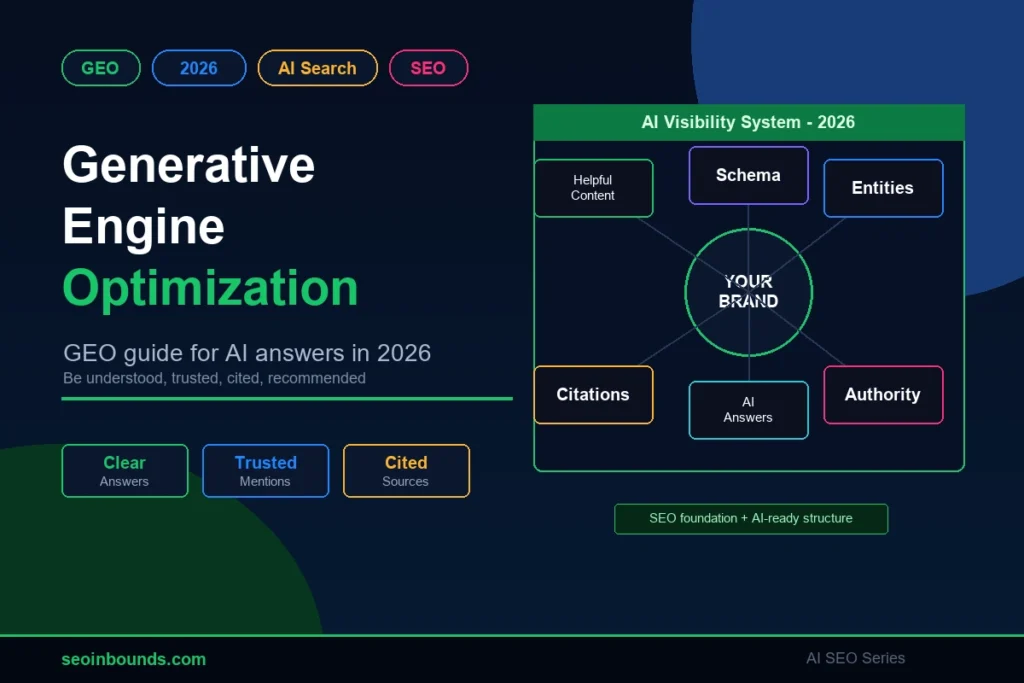
Generative engine optimization is the new layer of SEO that focuses on how your brand appears inside AI-generated answers. Traditional SEO asks, “Can we rank on page one?” GEO asks, “Can AI systems understand us, trust us, cite us, and recommend us when someone asks a relevant question?” That shift matters because search is no longer only a list of blue links. In 2026, people are asking Google AI Overviews, AI Mode, ChatGPT Search, Perplexity, Gemini, Claude, and Copilot for direct answers.
Here is the good news: GEO does not replace SEO. It builds on it. Crawlable pages, helpful content, topical authority, internal links, backlinks, brand mentions, and clean technical SEO still matter.
The difference is that your content also needs to be easy for an AI system to summarize, verify, and connect to a clear entity. If your current SEO foundation is weak, start with what is off-page SEO and the off-page SEO checklist before chasing advanced AI visibility tactics.
Generative engine optimization, often called GEO, is the process of improving your visibility in AI-generated answers. The goal is to make your website, brand, people, products, and claims easy for generative engines to find, understand, trust, and cite.
GEO works best when you combine helpful content, clear entity signals, structured pages, original information, strong internal links, quality backlinks, and trusted third-party mentions.
What Is Generative Engine Optimization?
Generative engine optimization is the practice of optimizing digital content and brand presence for answer-generating systems. These systems do not simply show ten links and let the user click around. They pull information together and create an answer. Sometimes they cite sources. Sometimes they mention brands. Sometimes they summarize without much visible attribution. That makes visibility harder to measure, but also more important.
In simple terms, GEO is about becoming a source that AI systems can confidently use. That means your content must be clear, specific, accurate, crawlable, and supported by outside signals. If an AI system has to guess what you mean, your content is not ready. If your brand appears nowhere outside your own site, your authority is harder to confirm.
GEO vs SEO: What Is the Difference?
| Area | Traditional SEO | Generative Engine Optimization |
| Main goal | Rank pages in search results. | Get cited, mentioned, or used in AI-generated answers. |
| Primary surface | Google results, Bing results, featured snippets, organic listings. | AI Overviews, AI Mode, ChatGPT Search, Perplexity, Gemini, Claude, Copilot. |
| Content style | Helpful pages that satisfy search intent. | Helpful pages with direct answers, clean structure, clear entities, and source-friendly sections. |
| Authority signal | Backlinks, content quality, topical authority, user satisfaction. | Backlinks, brand mentions, entity clarity, citations, third-party validation, content freshness. |
| Measurement | Rankings, clicks, impressions, conversions. | AI citations, brand mentions, answer share, prompt visibility, sentiment, referral traffic. |
| Risk | Over-optimization, thin content, spammy links. | Vague claims, unverified facts, poor entity signals, no outside mentions, generic AI-style content. |
The two are connected. A page that is invisible to search engines, buried in poor structure, and unsupported by links is unlikely to become a trusted AI source. GEO is not a trick. It is stronger SEO with clearer facts, better structure, and stronger trust signals.
Why GEO Matters in 2026
AI search is changing how users make decisions. A person might not search “best SEO agency” and open five websites anymore. They may ask an AI assistant, “What should a small business look for in an SEO agency?” or “Which link building tactics are safe in 2026?” The answer they see can shape what they believe before they ever reach a traditional search result.
That creates a new type of competition. You are not only competing for rankings. You are competing to be included in the answer. If your brand, data, examples, and pages are easy to understand, you have a better chance. If your content is generic, thin, or disconnected from outside authority, AI systems have little reason to use it.
How Generative Engines Choose Sources
No public checklist explains every source-selection detail across every AI platform. Still, the pattern is becoming clear. Generative systems tend to prefer content that is relevant, accessible, clear, current, and supported by trust signals. They also need pages that answer the question without making the model work too hard.
A strong GEO-ready page usually has:
- A direct answer near the top of the page.
- Clear headings that map to real questions.
- Named entities: brands, people, tools, methods, platforms, dates, and categories.
- Original examples, checklists, data, screenshots, templates, or workflows.
- Citations or references when making factual claims.
- Internal links to supporting pages in the same topic cluster.
- External mentions from trusted websites, communities, directories, or publications.
- A clean page structure that search engines and crawlers can access.
The GEO Framework: Make Your Brand Citeable
Most GEO advice becomes confusing because people jump straight into tools. Tools can help, but the foundation is simpler. A citeable brand has four layers: content clarity, entity clarity, authority signals, and measurement.
| Layer | What It Means | What To Do |
| Content clarity | AI systems can quickly understand the answer. | Use direct answers, short explanations, examples, FAQs, tables, and comparison sections. |
| Entity clarity | AI systems know who you are and what you are known for. | Keep brand, author, service, location, and topic information consistent across your site and profiles. |
| Authority signals | Other websites confirm your expertise. | Earn mentions, backlinks, citations, guest posts, press coverage, and community references. |
| Measurement | You track where AI systems mention or cite you. | Run prompt checks, track citations, monitor competitors, and update pages based on gaps. |
Step 1: Build a Strong SEO Foundation First
If your website has weak SEO, GEO will be harder. Start with the basics: make sure search engines can crawl your pages, submit key URLs, fix internal links, publish helpful content, and build a clean backlink profile. For discovery and indexing, use the guide on free URL submission to search engines. For broad foundational visibility, use free SEO submission sites.
This matters because many AI systems still depend on the web. If your content is hard to crawl or rarely referenced, it is harder for AI systems to use it confidently.
Step 2: Write Direct Answers Before Deep Explanations
A common mistake is hiding the answer under a long introduction. AI systems and human readers both prefer clarity. Start important sections with the answer. Then explain the details. If the heading is “What is generative engine optimization?” the first sentence should answer that question directly.
This does not mean your article should become robotic. It means your structure should be generous. Say the useful thing early. Then add examples, context, mistakes, and next steps.
Step 3: Create Entity-Rich Content
Entity-rich content helps AI systems understand the subject clearly. For GEO, entities can include your brand name, founder, author, services, product categories, industry terms, tools, methods, competitors, locations, and related topics. A page about generative engine optimization should naturally mention AI Overviews, AI Mode, ChatGPT Search, Perplexity, Gemini, Claude, Copilot, AI visibility, entity SEO, citations, topical authority, and content structure.
Do not stuff terms into the page. Use them when they help the reader. The goal is not to sound like a keyword database. The goal is to make the topic unambiguous.
Step 4: Build Topic Clusters, Not One-Off Posts
One article rarely builds enough authority by itself. A site that wants to own AI SEO should publish a cluster. This article can be the first page in that cluster. Then you can add answer engine optimization, Google AI Overviews SEO, AI SEO tools, AI visibility tracking, and AI content optimization.
For SEO Inbounds, the advantage is that the existing link-building cluster already supports authority. GEO still needs backlinks and mentions. That is why pages like how to build backlinks for free, dofollow vs nofollow backlinks, and free guest posting sites can support this new AI SEO cluster.
Step 5: Earn Mentions Outside Your Website
GEO is not only on-page optimization. AI systems need confidence, and third-party validation helps create that confidence. Mentions from niche blogs, directories, podcasts, forums, press releases, guest posts, business listings, and industry resources can all support your brand footprint.
This is where link building and GEO overlap. You do not need thousands of links. You need relevant proof that your site is part of the conversation. Use business listing sites, free profile creation sites, forum posting sites, and free press release submission sites carefully to build a cleaner public footprint.
Step 6: Use Structured Data, But Do Not Depend on It Alone
Structured data can help search engines understand your page, especially for articles, organizations, authors, breadcrumbs, FAQs, products, reviews, and local businesses. But schema is not magic. Bad content with schema is still bad content. Use structured data to support already-clear pages.
For GEO, schema works best when the visible page matches the structured data. If your author bio says one thing, your organization page says another, and your profiles say something else, the signals become messy.
Step 7: Make Content Easy to Quote
AI answer systems often need short, clear explanations. Give them quotable blocks. Add definitions, quick answers, comparison tables, checklists, statistics, examples, and concise summaries. A page with only long paragraphs is harder to parse. A page with clear answer blocks is easier for both humans and machines.
Good GEO content sounds human but has clean information design. It does not ramble. It does not bury the point. It uses plain language and then adds depth where the reader needs it.
Step 8: Refresh Content More Often
GEO changes faster than classic evergreen SEO. AI search platforms update interfaces, citations, crawling behavior, and answer formats. A GEO guide from 2024 can feel old quickly. That is why every AI SEO article on SEO Inbounds should show the year 2026, reference current platforms, and include a visible update habit.
Refresh pages when Google changes AI features, when ChatGPT Search changes source behavior, when Perplexity changes citation patterns, or when your own prompt checks reveal gaps.
GEO Checklist for 2026
| Task | Why It Matters | Status |
| Add a direct answer near the top | Helps AI systems and readers understand the page quickly. | Required |
| Use clean H2/H3 questions | Makes content easier to parse and cite. | Required |
| Define entities clearly | Builds brand and topic clarity. | Required |
| Add original examples | Makes the page harder to replace with generic AI content. | Required |
| Use internal links | Shows topical relationships inside your site. | Required |
| Earn external mentions | Supports trust and source confidence. | Required |
| Keep pages crawlable | AI/search systems need access to read the content. | Required |
| Use schema where helpful | Adds machine-readable context. | Recommended |
| Track AI citations | Shows whether GEO work is visible. | Recommended |
| Update content regularly | Keeps answers current for fast-changing AI search. | Recommended |
How to Measure GEO
GEO measurement is still messy in 2026. Traditional SEO tools give rankings and traffic. AI search visibility is less standardized. Still, you can track useful signals:
- Whether AI systems mention your brand for target prompts.
- Whether your URLs are cited in AI answers.
- Which competitors appear more often than you.
- What sentiment AI systems attach to your brand.
- Which third-party sources AI systems use when discussing your niche.
- Whether AI referrals appear in analytics.
- Whether pages that earn AI mentions also gain branded search demand.
Do not obsess over one prompt. Track groups of prompts around buyer questions, comparison searches, beginner questions, local questions, and problem-solving questions. GEO is about answer visibility across patterns.
GEO Mistakes to Avoid
- Publishing generic AI-written content with no original insight.
- Treating GEO as a replacement for SEO fundamentals.
- Ignoring backlinks, citations, and third-party validation.
- Writing vague brand pages that do not explain who you help.
- Blocking important crawlers without understanding the visibility tradeoff.
- Relying only on schema while the visible content stays weak.
- Trying to optimize for every AI platform with the same measurement method.
- Forgetting that people still need to trust and enjoy the content.
A 30-Day GEO Action Plan
| Week | Action | Goal |
| Week 1 | Audit your top pages for direct answers, crawlability, headings, author details, and internal links. | Fix the foundation. |
| Week 2 | Create or update entity pages: About, author bio, service pages, glossary pages, and topic hubs. | Make the brand easier to understand. |
| Week 3 | Publish one GEO-ready article and repurpose it into a PDF, infographic, or short video. | Create citeable assets. |
| Week 4 | Earn mentions through guest posts, forums, press releases, profiles, and relevant directories; then track AI prompts. | Build authority and measure visibility. |
Repurposing matters because AI visibility is not limited to one page. A guide can become a PDF on PDF submission sites, a visual for infographic submission sites, and a discussion starter in relevant communities.
Final Thoughts
Generative engine optimization is not a magic trick. It is the natural next step for SEO. If your content is clear, useful, structured, current, and supported by real authority, you are already moving in the right direction. If your content is vague, generic, isolated, and unsupported by outside mentions, AI systems have little reason to cite it.
For SEO Inbounds, the opportunity is strong. The site already has a growing link-building foundation. Now the next move is to connect that authority to AI search topics: GEO, AEO, Google AI Overviews SEO, AI SEO tools, and AI visibility tracking. That is how the site can become more than a backlink-list blog. It can become a practical SEO library for how search works now.
FAQs
What is generative engine optimization?
Generative engine optimization is the practice of making your brand, content, and expertise easier for AI answer engines to understand, trust, cite, and recommend in generated answers.
Is GEO different from SEO?
Yes and no. GEO is not a replacement for SEO. It is a newer layer of search visibility focused on AI-generated answers, citations, entity understanding, and source selection. Strong SEO still supports GEO because AI systems often rely on crawlable, useful, trusted web content.
Which platforms does GEO target?
GEO usually targets AI-powered search and answer systems such as Google AI Overviews, AI Mode, ChatGPT Search, Perplexity, Gemini, Claude, Copilot, and other generative answer interfaces.
Does GEO require backlinks?
Backlinks are not the only GEO signal, but trusted third-party mentions, citations, and links can help AI systems understand that a brand is real and referenced by others. Quality matters more than link volume.
How do you optimize content for generative engines?
Create direct answers, define entities clearly, cite sources, add original examples, use clean headings, build topical authority, earn trusted mentions, keep pages crawlable, and publish content that answers real questions better than generic summaries.
Can a small website rank or appear in AI answers?
Yes, but it usually needs narrow topical authority. A small website has a better chance when it owns a specific niche, publishes useful original content, earns relevant mentions, and structures pages so AI systems can quickly understand them.
What are GEO tools?
GEO tools usually track brand visibility, AI citations, prompt results, competitor mentions, sentiment, source overlap, and content gaps across AI search platforms. The category is still changing quickly in 2026.
What should I do first for GEO?
Start with SEO basics: crawlable pages, strong internal links, helpful content, schema where appropriate, clean entity information, and a focused content cluster. Then add GEO-specific tracking, citations, expert pages, and off-page authority building.