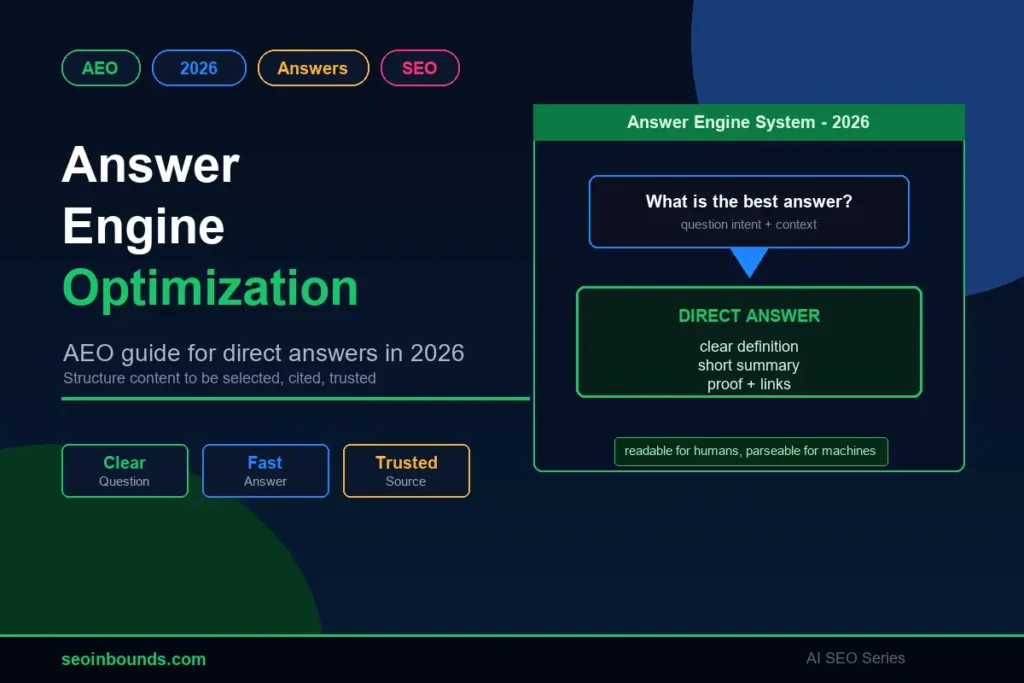
Answer engine optimization is the part of modern SEO that helps your content become the answer, not just another result. That matters more in 2026 because searchers are no longer getting answers only from traditional Google results.
They are reading featured snippets, Google AI Overviews, AI Mode responses, ChatGPT Search answers, Perplexity citations, Gemini summaries, Copilot responses, and voice assistant results.
The big idea is simple: if your page answers a real question clearly, proves the answer with useful detail, and sits inside a trusted topic cluster, it has a better chance of being selected by answer engines.
AEO is closely related to generative engine optimization, but it has a slightly different job. GEO focuses on being cited or recommended in generated AI answers. AEO focuses on structuring your content so it can serve as the direct answer.
Answer engine optimization, or AEO, is the process of optimizing content so search engines, AI tools, and voice assistants can understand it and use it as a direct answer.
AEO works by matching search intent, using clear question-based headings, giving concise answers, adding supporting context, using structured data where useful, building topical authority, and earning trust through internal links, backlinks, citations, and brand mentions.
What Is Answer Engine Optimization?
Answer engine optimization is not a new name for keyword stuffing. It is a cleaner way to organize useful information. AEO asks: what question is the user asking, what answer would actually help, and how can we make that answer easy for both people and machines to understand?
A classic SEO page may try to rank for a keyword. An AEO-ready page tries to answer the question behind the keyword. That means the page needs direct answers, examples, definitions, comparisons, FAQs, and clear structure. It should feel easy for a beginner to read and easy for an answer engine to parse.
AEO vs SEO vs GEO
| Area | SEO | AEO | GEO |
| Goal | Rank pages in search results. | Become the direct answer. | Get cited, mentioned, or recommended in AI-generated answers. |
| Main surface | Organic results, local results, image/video results. | Featured snippets, AI Overviews, voice answers, answer boxes. | ChatGPT Search, Perplexity, Gemini, Claude, Copilot, AI Overviews. |
| Content need | Helpful content that satisfies search intent. | Concise answers with supporting proof. | Citeable content, entity clarity, mentions, authority, and source-friendly structure. |
| Best format | Guides, landing pages, tools, comparisons, lists. | Definitions, steps, FAQs, tables, summaries, how-to blocks. | Original insights, clear entities, citations, research, expert content, comparisons. |
| Measurement | Rankings, clicks, impressions, conversions. | Snippet wins, answer visibility, voice answer coverage, AI answer inclusion. | AI citations, prompt visibility, brand mentions, competitor share, sentiment. |
You do not need to choose only one. A strong SEO article can also be AEO-ready and GEO-ready. The difference is where you place the emphasis. For SEO Inbounds, the smart approach is to build pages that rank, answer, and get cited.
Why AEO Matters in 2026
AEO matters because search behavior is becoming more answer-first. A user might ask, “What is the difference between dofollow and nofollow backlinks?” and get a direct AI answer before clicking any page. Another user might ask a voice assistant, “How do I build backlinks for free?” and hear a short summary. If your site is not structured to answer these questions clearly, another source may become the answer instead.
This is especially important for an SEO site. People come to SEO Inbounds because they want clear help with SEO, link building, backlinks, submissions, and now AI search. If your pages answer questions better than generic competitors, you can build topical authority across the whole domain.
How Answer Engines Choose Answers
No answer engine publishes a simple public formula. Still, the pattern is clear. Answer engines prefer content that is relevant, clear, trusted, current, and easy to extract. They need confidence that the answer is accurate and that the source is worth showing.
AEO-ready content usually has:
- A clear answer near the top of the section.
- Headings that match real questions.
- Plain-language definitions.
- Short paragraphs with useful context.
- Tables that compare confusing ideas.
- Step-by-step instructions when the query is task-based.
- FAQ sections for related questions.
- Internal links to deeper supporting pages.
- External trust signals such as backlinks, citations, and brand mentions.
The AEO Content Formula
A practical AEO section follows a simple rhythm: answer first, explain second, prove third, guide fourth. That structure keeps the content readable and helps answer engines identify the useful part quickly.
| Part | What To Include | Example |
| Answer | One or two direct sentences. | AEO is the process of optimizing content to become a direct answer. |
| Explain | A short plain-language explanation. | It helps search engines and AI tools understand the answer quickly. |
| Prove | Examples, data, sources, screenshots, or comparisons. | Use a table showing AEO vs SEO vs GEO. |
| Guide | Next steps or related resources. | Link to a checklist, deeper guide, or supporting article. |
Step 1: Start With Real Questions
AEO starts with questions, not just keywords. A keyword like answer engine optimization hides several questions: what is AEO, how does AEO work, is AEO different from SEO, what are AEO tools, and how do I optimize for answer engines? Each question can become a section.
Use Google suggestions, People Also Ask, Search Console queries, customer questions, forum threads, Reddit discussions, and your own sales or support questions. Then group questions by intent: definition, comparison, process, tool, example, mistake, measurement, and buying decision.
Step 2: Put the Direct Answer Near the Top
Do not make the reader dig. If the heading asks “What is AEO?” answer it immediately. You can add nuance after the answer. This is one reason many high-ranking guides feel clear: they do not hide the point behind a long preface.
This does not make the writing robotic. Good AEO writing sounds human but organized. It says the useful thing first, then gives the reader enough context to trust it.
Step 3: Use Simple Headings and Clean Structure
Answer engines rely heavily on structure. A messy article with clever headings can be harder to interpret than a direct article with plain headings. Use headings like “What is answer engine optimization?” “AEO vs SEO” and “How do you measure AEO?” These match the way people ask questions.
This also improves user experience. A beginner can scan the page, find the answer, and keep reading if they need more depth.
Step 4: Add FAQ Schema Where It Makes Sense
FAQ sections are useful because they collect related questions in a clean format. FAQ schema can help search engines understand the question-and-answer structure, but it is not a shortcut. The visible content still needs to be helpful and accurate.
Use FAQ schema for real questions, not fake keyword variations. If users are asking whether AEO is replacing SEO, answer that directly. If they are asking how AEO differs from GEO, link naturally to your generative engine optimization guide.
Step 5: Build Topic Authority With Internal Links
AEO works better when a page sits inside a strong content cluster. One article about AEO is helpful, but a cluster is stronger. The cluster should include GEO, Google AI Overviews SEO, AI SEO tools, SEO trends, technical SEO, on-page SEO, and link building.
For SEO Inbounds, internal links should connect AI search content to your existing SEO foundation. Link to what is off-page SEO, off-page SEO checklist, how to build backlinks for free, and dofollow vs nofollow backlinks where the context is natural.
Step 6: Support Answers With Authority Signals
Answer engines do not only need text. They need trust. That trust can come from clear author information, original examples, topical depth, third-party mentions, citations, backlinks, business profiles, guest posts, and community references. This is where link building still matters.
Use a balanced authority plan: publish helpful content, build clean profiles, earn guest posts, answer real forum questions, and repurpose strong articles into PDFs or visuals. Pages like free profile creation sites, business listing sites, free guest posting sites, and forum posting sites can support that footprint.
Step 7: Make Examples Part of the Content
Examples make AEO content easier to trust. A definition is useful, but an example makes it stick. If you explain title tags, show a good title and a weak title. If you explain backlinks, show a natural anchor and a risky anchor. If you explain AEO, show the exact structure of an answer-ready section.
| Weak Section | AEO-Ready Section |
| Long intro before answering. | Direct answer in the first two sentences. |
| Creative heading that hides intent. | Question-based heading that matches the query. |
| No examples or proof. | Example, table, or checklist included. |
| No related links. | Natural internal links to deeper guides. |
| Generic summary. | Specific next steps for the reader. |
Step 8: Optimize for Voice Search Without Sounding Strange
Voice search is still part of AEO because voice assistants need short, spoken answers. The easiest way to optimize is to write like a helpful person. Use natural questions, clear answers, and simple sentence structure. Avoid stiff wording that sounds like it was written for a machine.
A good voice-ready answer is short enough to read aloud but useful enough to stand on its own. Then the rest of the page can go deeper.
AEO Checklist for 2026
| Task | Why It Matters | Priority |
| Match one real question per section | Helps answer engines map content to queries. | High |
| Answer in the first few lines | Improves snippet and AI answer extraction. | High |
| Use plain H2/H3 headings | Makes content easier to parse. | High |
| Add examples and comparisons | Builds trust and usefulness. | High |
| Use FAQ schema when appropriate | Clarifies question-answer structure. | Medium |
| Add internal links | Builds topical relationships. | High |
| Earn relevant mentions | Supports authority and confidence. | High |
| Keep pages crawlable | Answer engines need access. | High |
| Update content regularly | Keeps answers accurate in 2026. | Medium |
| Track answer visibility | Shows what is working. | Medium |
How to Measure AEO
AEO measurement is not as clean as traditional ranking reports, but you can still track progress. Watch featured snippet wins, People Also Ask visibility, AI citation appearances, prompt mentions, voice-style query rankings, Search Console questions, and referral traffic from answer platforms.
- Track which pages appear for question-based queries.
- Monitor whether Google shows your content in snippets or AI surfaces.
- Run prompt checks in ChatGPT Search, Perplexity, Gemini, and Copilot.
- Compare your answer coverage against competitors.
- Watch branded searches after AI visibility increases.
- Track conversions from pages that answer high-intent questions.
AEO Mistakes to Avoid
- Writing long introductions that delay the answer.
- Using clever headings that hide the real question.
- Publishing generic AI-written content with no examples.
- Adding FAQ schema to weak or fake questions.
- Ignoring internal links and topic clusters.
- Forgetting backlinks, citations, and off-page authority.
- Blocking important pages from crawling.
- Treating AEO as a replacement for normal SEO.
30-Day AEO Action Plan
| Week | Action | Goal |
| Week 1 | Choose 10 high-value questions from Search Console, Google suggestions, and competitor pages. | Build the question map. |
| Week 2 | Rewrite the top sections of important pages with direct answers, examples, and cleaner headings. | Make existing pages answer-ready. |
| Week 3 | Add FAQs, internal links, schema where appropriate, and supporting visuals or tables. | Improve structure and trust. |
| Week 4 | Promote the best answer assets through profiles, forums, guest posts, PDFs, and citations. | Build authority around the answers. |
This plan connects naturally to your existing link-building resources, including free backlink submission sites, PDF submission sites, infographic submission sites, and free URL submission to search engines.
Final Thoughts
Answer engine optimization is not hype when you treat it practically. It is the discipline of making your content easier to understand, easier to trust, and easier to select as the answer. That helps humans first. It also helps search engines, AI tools, and voice assistants.
For SEO Inbounds, AEO is a strong next cluster because the site already explains SEO and link building. The next step is to make those explanations answer-ready. Clear answers, strong internal links, trusted mentions, and useful examples can help the site compete with bigger SEO publishers over time.
FAQs
What is answer engine optimization?
Answer engine optimization is the practice of structuring and improving content so answer engines can understand it, trust it, and select it as a direct answer for searchers.
Is AEO different from SEO?
AEO is not a replacement for SEO. SEO focuses on ranking pages in search results, while AEO focuses on becoming the answer in featured snippets, AI Overviews, voice search, chat-based search, and other answer surfaces.
Is AEO the same as GEO?
AEO and GEO overlap, but they are not exactly the same. AEO focuses on direct answers and answer surfaces. Generative engine optimization focuses more broadly on being cited, mentioned, or recommended inside AI-generated responses.
Why does AEO matter in 2026?
AEO matters because more users expect direct answers from Google AI Overviews, AI Mode, ChatGPT Search, Perplexity, Gemini, Copilot, and voice assistants. If your content is not answer-ready, it may be skipped even when it is useful.
How do you optimize for answer engines?
Start with clear question-based headings, direct answers, concise summaries, examples, schema where useful, strong internal links, crawlable pages, author trust, and supporting backlinks or mentions.
Can small websites win with AEO?
Yes. Small websites can win when they answer specific questions better than broad competitors, build topical authority in a narrow area, and make their pages easy to understand and cite.
What are AEO tools?
AEO tools help track AI citations, featured snippets, answer visibility, prompt mentions, competitor coverage, schema issues, and content gaps. The category is still developing quickly in 2026.
What is the first AEO task I should do?
Choose one important page and rewrite the top section so it answers the main search question clearly in the first few lines. Then add supporting examples, FAQs, internal links, and schema if appropriate.