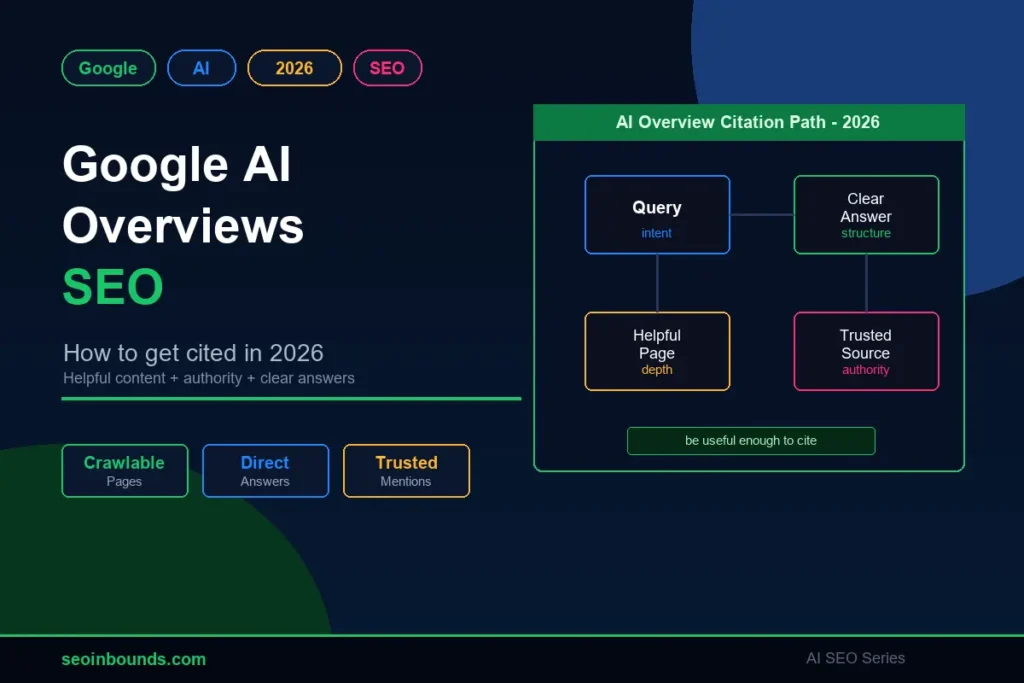
Google AI Overviews SEO is not about tricking Google into quoting your page. It is about making your content useful enough, clear enough, and trustworthy enough to be selected when Google generates an AI answer. That is a different mindset from old-school ranking tactics. You still need strong SEO, but now your page also needs to work as a source: easy to understand, easy to verify, and worth showing to users who want a fast answer.
This guide explains what actually matters in 2026: helpful content, answer-ready structure, crawlability, entity clarity, backlinks, brand mentions, and measurement. If you already read the SEO Inbounds guides on generative engine optimization and answer engine optimization, think of this article as the Google-specific version of that strategy.
To improve your chances of being cited in Google AI Overviews, create content that directly answers the search intent, is easy for Google to crawl, uses clear headings, includes original examples or evidence, links to supporting pages, earns trusted mentions, and follows normal SEO best practices.
There is no guaranteed AI Overview citation formula, but pages that are helpful, specific, structured, and authoritative have a better chance than generic pages.
What Are Google AI Overviews?
Google AI Overviews are AI-generated summaries that appear for some searches. Instead of only showing traditional organic results, Google may generate a short answer and include links to sources that support the response. The exact layout changes, and not every query triggers an AI Overview. But the direction is obvious: Google is becoming more answer-first.
For website owners, this creates a new challenge. You do not only want to rank below the AI answer. You want your content to be useful enough to appear inside or near the AI answer. That means your page needs to satisfy both human readers and Google’s systems.
Is Google AI Overviews SEO Different From Normal SEO?
| Area | Traditional SEO | Google AI Overviews SEO |
| Goal | Rank pages in organic search results. | Become a trusted source for an AI-generated answer. |
| Content style | Helpful pages that match search intent. | Helpful pages with direct answers, evidence, structure, and citeable sections. |
| Authority | Backlinks, topical authority, content quality, user satisfaction. | Same foundations, plus entity clarity, source credibility, original information, and answer readiness. |
| Measurement | Rankings, clicks, impressions, conversions. | AI Overview appearances, citations, cited competitor sources, impressions, clicks, and brand visibility. |
| Risk | Thin content, spammy links, over-optimization. | Generic AI content, vague claims, weak sources, poor structure, and missing authority signals. |
The foundation is still SEO. If Google cannot crawl your page, understand your topic, or trust your site, AI Overview visibility becomes much harder. Start with technical basics, helpful content, and internal linking before worrying about advanced AI search tactics.
How Google AI Overviews Choose Sources
Google does not publish a simple list of ranking factors for AI Overview citations. That would be too easy to manipulate. But Google’s public guidance keeps pointing in the same direction: create helpful, reliable, people-first content and make sure Google can access it. In practice, pages that get used as sources often have strong relevance, clear answers, useful detail, and enough trust signals to support the response.
A citeable page usually has:
- A direct answer near the top of the page.
- A clear explanation that matches the search intent.
- Original examples, data, steps, screenshots, templates, or comparisons.
- Specific entity information, not vague generic wording.
- Clean headings and short sections that are easy to parse.
- Internal links to deeper supporting pages.
- External authority signals such as backlinks, brand mentions, and citations.
- Crawlable content that is not hidden behind scripts or blocked resources.
Step 1: Make the Page Crawlable First
Before you optimize for AI Overviews, make sure Google can read the page. This sounds basic, but it is the first place many sites fail. Important content should be accessible, indexable, and supported by normal internal links. Submit important URLs and sitemaps when needed. For that foundation, use the SEO Inbounds guide on free URL submission to search engines.
Do not hide the main answer behind tabs, heavy scripts, or blocked resources. If the best part of the page is hard to access, it is harder for Google to use.
Step 2: Answer the Query Immediately
AI Overviews are built around answers. If your page takes five paragraphs to get to the point, another source may be easier to use. Put a concise answer near the top, then add depth. This does not make the article shallow. It makes the article useful.
A good AI Overview-ready section follows this pattern: answer first, explain second, prove third, link deeper fourth. That is also the structure used in strong answer engine optimization.
Step 3: Add Original Information
Generic summaries are easy to replace. Original information is harder to ignore. If every site says the same thing about AI Overviews, Google has many options. But if your page includes a useful checklist, example, test, comparison, screenshot, workflow, or expert explanation, it becomes more citeable.
| Weak Content | Stronger AI Overview Source |
| Generic definition only. | Definition plus examples, use cases, and mistakes. |
| No proof or process. | Clear steps, checklist, screenshots, or a repeatable workflow. |
| Broad claims. | Specific claims with context and sources. |
| Thin AI-written overview. | Human explanation with experience, judgment, and practical next steps. |
| One isolated article. | Article connected to a topic cluster with internal links. |
Step 4: Build Topic Clusters Around AI Search
Google AI Overviews SEO should not sit alone. It belongs inside an AI SEO cluster. On SEO Inbounds, that cluster now includes generative engine optimization and answer engine optimization. Next, it can expand into AI SEO tools, SEO trends, AI visibility tracking, and content optimization for AI search.
Internal links help Google understand relationships between pages. They also help readers move from a broad concept to a specific tactic. That is how SEO Inbounds can become a full SEO library, not only a collection of separate posts.
Step 5: Strengthen Authority With Mentions and Links
Backlinks are not a magic AI Overview switch, but authority still matters. A page that is referenced by other relevant sites is easier to trust than a page with no footprint. The goal is not to chase thousands of links. The goal is to earn enough relevant mentions that your brand and content look real.
Use a balanced authority plan. Build a clean base with free SEO submission sites, publish supporting assets, earn guest posts through free guest posting sites, answer real questions on forum posting sites, and keep your backlink profile natural using the guide on dofollow vs nofollow backlinks.
Step 6: Use Structured Data Carefully
Structured data can help Google understand a page, but it does not replace helpful content. Use schema when it matches the visible page: Article, Organization, Person, Breadcrumb, FAQ, HowTo, Product, Review, or LocalBusiness where appropriate. Keep it accurate and consistent.
For AI Overviews, schema is best treated as supporting context. The visible content still has to answer the question. If the page is weak, schema will not save it.
Step 7: Make Your Brand and Authors Clear
AI-generated answers need trust. Clear authorship helps. Add author bios, update dates, organization details, contact information, and topic expertise where appropriate. If an article gives SEO advice, the reader should know why the source is worth listening to.
Entity clarity also matters. Keep your brand name, niche, author names, service descriptions, and social or profile details consistent across your site and trusted third-party profiles. You can support that with business listing sites and free profile creation sites.
Step 8: Optimize for Clicks, Not Only Citations
A citation is useful, but the real win is a qualified visitor. If Google cites your page, the title and surrounding context still need to make someone want to click. Write titles that are clear and specific. Use meta descriptions that explain the value. Add original assets that make the page worth visiting beyond the AI summary.
This is where deeper content helps. A short answer may get cited, but a full checklist, template, table, image, or PDF gives the user a reason to open the page. You can repurpose strong guides through PDF submission sites and infographic submission sites to strengthen the wider content footprint.
Google AI Overviews SEO Checklist
| Task | Why It Matters | Priority |
| Make the page crawlable and indexable | Google needs access before it can use the page. | High |
| Answer the query near the top | AI Overviews need clear answer material. | High |
| Use plain question-based headings | Helps users and systems understand the structure. | High |
| Add original examples or evidence | Makes the page more citeable than generic content. | High |
| Build internal links | Shows topical relationships and supports discovery. | High |
| Earn relevant mentions and backlinks | Supports trust and authority. | High |
| Use structured data where accurate | Adds machine-readable context. | Medium |
| Clarify authors and brand entities | Improves trust and entity understanding. | Medium |
| Refresh content regularly | AI search changes quickly. | Medium |
| Track AI Overview appearances | Shows what is working and where competitors win. | Medium |
How to Track Google AI Overviews Visibility
Tracking AI Overviews is still messy in 2026. Search results can vary by location, account, device, query wording, and time. Still, you can build a useful tracking system.
- Create a list of high-value questions and keywords.
- Record whether an AI Overview appears for each query.
- Note which sources Google cites or links.
- Compare cited pages against your page structure and authority.
- Track Search Console impressions, clicks, and query changes.
- Check whether branded searches grow after AI visibility improves.
- Update the page when competitors provide clearer answers.
Mistakes to Avoid
- Claiming you can guarantee AI Overview citations.
- Publishing generic AI-written content with no original value.
- Ignoring normal SEO foundations like crawlability and internal links.
- Writing long introductions before answering the query.
- Using schema that does not match the visible page.
- Chasing backlinks from irrelevant or spammy sources.
- Forgetting that AI Overview users still need a reason to click.
- Treating GEO, AEO, and AI Overviews SEO as separate silos.
30-Day Action Plan
| Week | Action | Goal |
| Week 1 | Pick 20 AI Overview target queries and study the cited sources. | Understand what Google is already using. |
| Week 2 | Rewrite important pages with direct answers, clean headings, examples, and supporting internal links. | Make pages AI Overview-ready. |
| Week 3 | Add original assets such as checklists, tables, PDFs, screenshots, or infographics. | Make the content more citeable. |
| Week 4 | Build authority through guest posts, profiles, forums, PR, and quality backlinks, then track query changes. | Support trust and visibility. |
Final Thoughts
Google AI Overviews SEO is not a shortcut. It is a stronger version of good SEO: helpful content, clear answers, crawlable pages, trusted authors, internal links, relevant backlinks, and original information. The sites that win will not be the ones repeating the same generic advice. They will be the ones that answer better, prove more, and build real authority around their topics.
For SEO Inbounds, this is a smart cluster to build now. The site already has strong link-building content. Adding AI Overviews SEO, AEO, GEO, and AI SEO tools gives the domain a path to compete with bigger SEO publishers while staying true to its core: practical SEO and link building that people can actually use.
FAQs
What is Google AI Overviews SEO?
Google AI Overviews SEO is the process of improving your content so it can be understood, trusted, and potentially cited or linked in Google AI Overviews for relevant searches.
Can you guarantee a citation in Google AI Overviews?
No. Nobody can honestly guarantee a Google AI Overview citation. You can improve your chances by publishing helpful, crawlable, well-structured, trusted content that answers the query clearly and supports claims with evidence.
Do rankings still matter for AI Overviews?
Yes. Traditional SEO still matters because Google needs to discover, understand, and trust sources. Ranking is not the only factor, but strong SEO foundations can support AI Overview visibility.
How do I optimize for Google AI Overviews in 2026?
Start with helpful content, direct answers, clean headings, original examples, author trust, internal links, crawlability, structured data where useful, and external authority signals such as quality backlinks and brand mentions.
Is Google AI Overviews SEO the same as AEO or GEO?
It overlaps with both. AEO focuses on direct answer readiness. GEO focuses on visibility in generative answer engines. Google AI Overviews SEO is a specific application of those ideas for Google’s AI answer surface.
Do backlinks help with Google AI Overviews?
Backlinks are not a simple AI Overview switch, but trusted mentions, citations, editorial links, and brand references can support authority. Quality and relevance matter more than link volume.
Should I block Google AI Overviews from using my content?
That is a business decision. If you want search visibility, make sure you understand Google’s controls and the tradeoff: limiting snippets or previews can affect how content appears across Google surfaces.
How do I track Google AI Overviews visibility?
Track target queries manually, use AI visibility tools where available, monitor Search Console changes, watch AI citation appearances, record which sources Google cites, and compare your content against cited competitors.