This is the question every website owner asks around week six of their SEO efforts, usually right after they have submitted their site to directories, built some backlinks, and checked Google Search Console for the tenth time to find… nothing has moved yet. If that is where you are, this guide is written specifically for you.
The honest answer to how long does off-page SEO take to show results in 2026 is this: most websites begin seeing measurable movement between three and six months, with meaningful traffic growth typically arriving between months four and nine.
For new websites with no prior authority, expect nine to twelve months before consistent results appear. For established sites with a clean backlink history, the off-page SEO results time frame shrinks to four to six months.
But the timeline is only part of the story. The more useful question is why it takes this long and what you can do within your control to push results toward the shorter end of that range.
That is what this guide covers: a verified month-by-month off-page SEO timeline 2026, the factors that slow things down, the signals that show you are on track, and the practical moves that speed things up without shortcuts that get sites penalized.
Why Off-Page SEO Takes Time What Google Is Actually Doing
Before looking at specific timeframes, it helps to understand what happens on Google’s side after you build a backlink or submit your site to a high-DA platform. Most people imagine Google as a real-time system that immediately rewards SEO work. It is not.
When a new backlink appears pointing to your site, Google goes through a sequence of steps before that link affects your rankings at all. Understanding this sequence is key to having realistic off-page SEO ranking factors expectations:
- Step 1 Discovery: Google’s crawlers have to find the page that contains your new link. For a high-DA platform like Scribd or a DA 90+ blog, this might happen within 24 to 48 hours. For lower-authority pages, it could take weeks.
- Step 2 Indexing: Google indexes the linking page. The link is now visible in its database, but this alone changes nothing about your rankings.
- Step 3 Evaluation: Google’s algorithm assesses the relationship between the linking domain and your site topical relevance, domain authority, anchor text, surrounding content. This backlink impact timeline step is where most of the wait happens.
- Step 4 Stability check: Google watches to see if the link remains live over weeks. Links that disappear quickly are discounted. Links that hold for 60+ days are given fuller weight.
- Step 5 Ranking signal integration: Only after all the above does the link begin contributing to your rankings and even then, it is one signal among hundreds that Google balances simultaneously.
According to data from agencies tracking how long for backlinks to show results, the average time from a high-quality backlink being published to a measurable ranking impact is six to ten weeks in 2026.
That is not a delay you can engineer around it is simply how Google trust signals timeline works. The algorithm is deliberately cautious because if links worked instantly, spammers would manufacture them at scale and dominate every SERP within days.
| 📌 Key Fact: A link from a DA 70+ domain can be indexed within 48 hours but may not influence your rankings for 8–10 weeks. Google waits to see if the link is stable, if it drives real referral traffic, and if the linking domain maintains its own quality signals before giving the link its full weight. |
How Long Does Off-Page SEO Take for a New Website?
How long does off-page SEO take for a new website? Longer than most people are prepared for and that is not a pessimistic statement, it is just the reality of how Google evaluates trust.
New domains go through what the SEO industry calls a new website SEO timeline probationary period: Google is skeptical of fresh sites because spam operations often register new domains, build links aggressively, and try to rank before getting caught.
Here is what the realistic timeline looks like for a brand-new website doing consistent, quality off-page SEO work from day one:
| Period | What Google Sees | What You See in GSC | What to Expect |
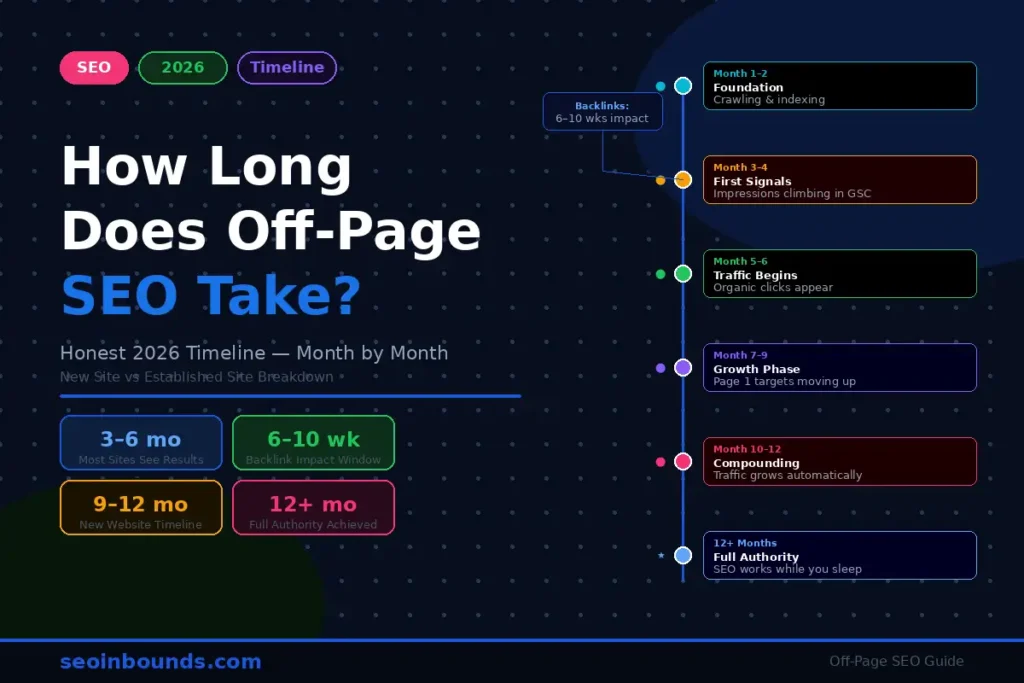
| Month 1–2 | Crawling, indexing new pages, logging early backlinks | Impressions starting, zero or near-zero clicks | Indexation confirmed, no ranking movement |
| Month 3–4 | Evaluating backlink quality, early trust accumulation | Impressions climbing, occasional position 20–50 appearances | First long-tail keyword movements, GSC showing activity |
| Month 5–6 | Comparing your content against established competitors | Position improvements for low-competition keywords | First organic clicks, traffic begins (slowly) |
| Month 7–9 | Rewarding consistency stable links, regular content | Noticeable click growth, target keywords moving to page 2 | Real referral traffic, some page-1 appearances |
| Month 10–12 | Full trust signals processing, authority compounding | Page 1 rankings for primary targets beginning | Consistent organic traffic, compounding growth |
| 12+ months | Domain authority established, Google treats site as trusted resource | Steady growth, ranking for unintended keywords | Full compounding SEO momentum |
The key insight for new sites: off-page SEO patience is not about waiting it is about building consistently during months when nothing visible is happening.
The brands that give up at month three because they see no traffic are abandoning exactly when Google is starting to take notice. The sites that push through to month six with consistent backlink building, quality content, and technical health are the ones that dominate month nine.
How Long Does It Take for Backlinks to Show Results in 2026?
How long does it take for backlinks to show results in 2026? The specific answer varies by link quality, platform authority, and your existing domain trust but here are the verified windows based on current SEO data:
- DA 70+ editorial backlinks (guest posts, niche sites): 6 to 10 weeks for measurable ranking impact. These are the most powerful links and Google processes them carefully. The backlink impact timeline here depends on how frequently Google crawls the linking domain and whether your site already has some trust established.
- DA 50–70 submission site backlinks (directories, profiles, press releases): 4 to 8 weeks to index, 8 to 12 weeks for any ranking influence. These links contribute to your authority profile cumulatively individually modest, collectively meaningful. Your directory submissions and press release submissions fall here.
- Social signals and bookmarking: 1 to 2 weeks for indexation, minimal direct ranking impact but meaningful for crawl frequency. Your social bookmarking activity speeds up how quickly Google discovers and revisits your pages which indirectly accelerates the whole off-page SEO timeline 2026.
- Profile links (DA 60–90): 2 to 4 weeks to index, contribute to brand entity signals within 4 to 8 weeks. Your profile creation sites build the foundational brand citation layer that makes all other links more credible.
- Nofollow links from high-DA platforms: No direct link equity, but indexed brand mentions on DA 85+ platforms contribute to Google’s entity understanding of your brand within 2 to 6 weeks of indexation. This is why video submission and image submission still matter despite being largely nofollow.
| 💡 Important: A single high-quality backlink from a DA 70+ domain will impact your rankings more than 50 low-DA directory submissions. But those 50 directory submissions together build the brand signal foundation that makes Google trust your site enough to value that DA 70+ link in the first place. Both layers of your off-page SEO ranking factors strategy are necessary they just work on different timescales. |
The Off-Page SEO Timeline: Month by Month
Here is the honest, no-fluff off-page SEO timeline 2026 for a website doing consistent, quality work across backlink building, content, and technical health. These windows assume you are using white-hat tactics quality guest posting, genuine forum participation, and real submission platforms not link farms or PBNs.
Months 1–2: The Foundation Phase
This is the when does off-page SEO start working question in practice and the honest answer is: it starts accumulating immediately, but nothing is visible yet. In months one and two, your job is to build the infrastructure that later months will compound on. Submit your site to search engines directly. Create consistent profiles on high-DA platforms.
Publish your first round of directory submissions and social bookmarking. What you see in GSC: crawl activity increasing, pages getting indexed, zero or near-zero clicks. What is actually happening: Google is building its initial model of what your site is about.
Months 3–4: The First Signals
This is where how long does link building take starts becoming visible in the data. If your months one to two work was done consistently, you will start seeing impressions climb in Google Search Console. Long-tail keywords you did not specifically target begin appearing in position 20 to 50. Your domain authority growth timeline shows early movement.
This is also when your first guest post backlinks from months one to two should be indexed and beginning to pass authority. What you see in GSC: impressions growing week over week, first keyword appearances in the coverage report. This is the phase most people abandon right before the results arrive.
Months 5–6: Traffic Begins
Month five to six is when the off-page SEO results time frame becomes tangible for most websites. Organic clicks start appearing. Keywords that were stuck at position 15 to 30 begin pushing toward the top ten. Your Web 2.0 content and article submissions from earlier months are now indexed, contributing multi-platform brand signals.
The SEO compounding effect begins: each new backlink builds on the authority established by previous ones, meaning the tenth link you earn has more impact than the first. What you see in GSC: first consistent organic sessions, position improvements across multiple target keywords.
Months 7–9: The Growth Phase
For most websites doing consistent how long does off-page SEO take correctly, months seven to nine are where SEO becomes genuinely exciting. Primary target keywords are on page one or knocking on its door. Organic traffic is compounding growing week over week without requiring proportionally more work.
Your press releases and PDF submissions are producing indexed pages that appear in their own search results, driving additional brand visibility. Established site SEO results often peak in this window. New sites may still be working toward it.
Months 10–12 and Beyond: Compounding Authority
By month ten, the SEO results time frame 2026 question has fully answered itself. Your site is either on page one for primary targets or has a clear trajectory toward it. The authority you have built compounds: new pages on your domain rank faster because the domain itself carries trust.
Links you earned in month two are still producing ranking signals in month twelve and beyond. This is the SEO compounding effect at full momentum and it is why brands that commit to twelve months of consistent off-page work end up with a competitive advantage that takes years for rivals to match.
Why Is My Off-Page SEO Not Showing Results?
Why is my off-page SEO not showing results even after months of consistent work? This is a fair question and the answer almost always comes down to one of five root causes:
- Technical issues blocking ranking. Backlinks cannot compensate for a site Google cannot crawl properly. If your pages are not indexed, your load speed fails Core Web Vitals thresholds, or you have duplicate content issues, off-page work stalls entirely. Check Google Search Console’s Coverage report before assuming your link building is ineffective.
- Low-quality or irrelevant backlinks. Links from unrelated niches, link farms, or platforms Google has devalued contribute nothing and enough of them can trigger a quality penalty. Every link in your off-page SEO checklist should come from a legitimate platform relevant to your content or industry.
- Targeting keywords that are too competitive too soon. A new site targeting high-volume, high-competition keywords will not rank for them in six months even with good backlinks. The new website SEO timeline requires starting with long-tail, low-competition keywords and building toward competitive terms as domain authority grows.
- Inconsistent effort. Sporadic SEO two months of activity, then silence, then a burst almost never produces results. Google rewards consistency. A modest but steady schedule of building backlinks for free every week outperforms intensive occasional pushes every time.
- Not enough time has passed. The most common reason off-page SEO appears not to be working is simply that not enough time has elapsed. If you are at month two or three, the answer is usually: keep going. The Google trust signals timeline does not compress no matter how much effort you apply in the short term.
How Many Backlinks Do I Need to See Results?
How many backlinks do I need to see results? This is one of those SEO questions that sounds like it should have a clean numeric answer and it genuinely does not. What Google evaluates is not backlink count but backlink quality, relevance, and diversity. Here is what the data actually shows:
- Low-competition niches: 10 to 30 high-quality backlinks from DA 40+ domains can be enough to rank on page one for long-tail keywords. This is achievable within 3 to 4 months of consistent effort using dofollow backlinks from guest posting, niche directories, and profile platforms.
- Medium-competition niches: 30 to 100 quality backlinks across a diverse range of DA 40–80 platforms, built over 6 to 9 months. Diversity matters here links from ten different domain types (directories, blogs, forums, press releases, PDFs) carry more weight than 100 links from the same platform type.
- High-competition niches: 100+ quality backlinks including editorial links from DA 70+ domains, built over 12+ months. No shortcut exists at this level. The domain authority growth timeline for competitive industries requires sustained, patient investment.
The practical takeaway: focus on earning one genuinely good backlink per week from a real platform, relevant to your niche, with a natural anchor text rather than chasing a specific count. Twelve weeks of consistent work gives you 12 quality links that build on each other. That is more valuable than 50 rushed links from the same directory list.
Does Off-Page SEO Work Faster Than On-Page SEO?
Does off-page SEO work faster than on-page SEO? No and this is one of the most important things to understand about sequencing your SEO work correctly.
On-page SEO changes fixing title tags, adding target keywords to headings, improving meta descriptions, resolving technical errors can produce visible ranking improvements within two to four weeks because Google can re-crawl and re-evaluate a page’s on-page signals quickly.
Off-page SEO requires third-party domains to link to you, Google to discover those links, evaluate them, and then reflect them in rankings a process that takes months, not weeks.
The correct sequencing is:
- On-page first. Make sure every page you want to rank is properly optimized before you build links to it. A backlink pointing to a poorly optimized page is wasted link equity.
- Technical health second. Ensure Google can crawl, index, and render your site without issues. Check GSC for crawl errors, submit your sitemap, and submit your URLs directly to search engines.
- Off-page third and sustained. Once the foundation is solid, build your off-page authority layer consistently. This is when does off-page SEO start working in practice: when the on-page and technical foundations are ready to receive and benefit from the authority backlinks bring.
Trying to accelerate rankings with backlinks before on-page SEO is done is like adding more fuel to an engine with a clogged filter. The fuel exists but cannot work properly.
How to Speed Up Off-Page SEO Results
While you cannot force Google to reward your work faster, you can eliminate the factors that slow the process down and maximize the quality of every action you take. Here is how to push results toward the short end of the SEO results time frame 2026 range:
- Request indexing in Google Search Console immediately after publishing. Every time you publish a new page or earn a new backlink on a high-DA platform, go to GSC → URL Inspection → Request Indexing. Never wait for Google to discover content naturally when you can accelerate crawling directly. This is the single fastest legitimate way to compress the off-page SEO timeline 2026.
- Target long-tail keywords first. New sites that target long-tail, specific phrases (less than 1,000 monthly searches) rank in 3 to 5 months. Sites that target head terms (10,000+ monthly searches) wait 12+ months. Build your authority through long-tail wins before moving up the competition ladder.
- Build backlinks to your backlinks. After your guest posts or press releases go live, bookmark those URLs on social bookmarking platforms. This accelerates crawling of the linking pages, which speeds up how quickly Google processes the authority flowing from those links to your site.
- Publish content consistently. Google crawls active sites more frequently. A site that publishes one new, well-optimized article per week gives Google a regular reason to revisit which means faster discovery of new backlinks and faster processing of off-page SEO ranking factors.
- Focus on link diversity before link volume. Ten links from ten different platform types (blog, forum, directory, press release, PDF, image, video, profile, Web 2.0, guest post) build domain authority growth timeline faster than ten links from ten directories. Diversity signals to Google that your authority is natural and multi-dimensional.
- Fix technical issues immediately. Every week your site has a crawl error, a noindex tag in the wrong place, or a speed issue that fails Core Web Vitals is a week of off-page work that produces less than it should. Keep GSC open, check it weekly, and resolve issues the day they appear.
| ⚡ The Single Biggest Accelerator: Consistency beats intensity every time in off-page SEO. Doing one quality action every day one directory submission, one bookmarked URL, one forum thread, one article published for 90 days straight produces dramatically better results than doing 90 things in one week and then stopping. Google’s algorithm rewards sustained signals over time. Build it into your weekly workflow and the off-page SEO results time frame compresses naturally. |
Frequently Asked Questions
Q1: How long does off-page SEO take to show results?
Most websites begin seeing measurable movement between three and six months of consistent work. New websites with no prior authority typically need nine to twelve months for consistent organic traffic.
Established sites with clean backlink histories often see the off-page SEO results time frame compress to four to six months. The primary variables are domain age, competition level, content quality, and the consistency of your link building activity.
Q2: How long does it take for backlinks to show results in 2026?
In 2026, the average time from a high-quality backlink being published to a measurable ranking impact is six to ten weeks. Google must first crawl the linking page, index it, evaluate the relationship between the two domains, watch for link stability, and integrate the signal into its ranking algorithm.
Lower-authority links from directories and profiles take four to eight weeks to index and eight to twelve weeks for any ranking influence. The backlink impact timeline shortens as your domain authority grows established sites process new links faster because Google already trusts them.
Q3: Why is my off-page SEO not showing results?
The most common reasons off-page SEO is not showing results: technical issues preventing proper crawling (check GSC Coverage report); low-quality or niche-irrelevant backlinks that Google ignores or discounts; targeting overly competitive keywords before domain authority is established; inconsistent effort sporadic activity never compounds the way sustained effort does; or simply not enough time most sites need four to six months before results appear even with perfect execution.
Follow the off-page SEO checklist to systematically identify and resolve whichever factor applies to your situation.
Final Thoughts: Off-Page SEO Is a Long Game Play It Deliberately
The brands that win with how long does off-page SEO take to show results are not the ones who find a way to make it faster. They are the ones who understand the timeline clearly enough to keep building during the months when nothing is visible which is exactly when the foundation for everything that comes later is being laid.
Three to six months for most sites. Nine to twelve for brand-new domains. Six to ten weeks for a quality backlink to impact rankings. These are the real numbers in 2026, verified across hundreds of campaigns and consistent with what Google’s own communications describe. Plan around them, not against them.
Your job during that window: build consistently. Submit to high-DA directories. Publish guest posts. Distribute press releases. Create Web 2.0 content. Build profile citations. Share via social bookmarking. Request indexing in GSC every time something goes live. Check the off-page SEO checklist monthly. Do those things for six months and the results are not a question of if only a question of when.