Picture a customer who finds your business on Google Maps, taps the phone number, and hears a stranger say, “Sorry, that’s not them anymore.” That customer is gone. The reason is usually boring. Somewhere online, an old directory listing still shows your old phone number or your old address. That is what a bad local citation looks like.
That is the whole story of local citations. A local citation is any place online that mentions your business name, address, and phone number. When these mentions are correct, they quietly back up your Google Business Profile. When they are wrong, they confuse customers and search engines at the same time.
This guide explains local citations in plain English, shows you how to fix NAP consistency without paying for a tool, and lists the free local citation sites that deserve your time. It also answers a question many guides dodge: how much do citations really matter in 2026? The short answer is that they matter less for rankings than they used to, more than zero, and in a new way for AI search.
What Are Local Citations? (Plain English)
If you are asking “what are local citations,” think of them as your business card, copied across the internet. Each copy lists the same basic facts. Those facts are called NAP, which stands for name, address, and phone number. Many people add a W for website, so you may also see NAP+W.
A citation does not need a link. A line of text on a directory page, a Chamber of Commerce member list, or a local news story can all count. What matters is that your business details appear on a site that is not your own.
Here are the places where citations usually live:
- Search and map platforms, such as Google Business Profile, Bing Places, and Apple Maps.
- Big directories, such as Yelp and Yellow Pages.
- Industry directories, such as listing sites for doctors, lawyers, restaurants, or contractors.
- Local sources, such as your Chamber of Commerce, neighborhood groups, and local newspapers.
- Social profiles, such as your Facebook business page.
Local SEO citations come in two types, and knowing the difference saves you time.
- Structured citations are listings in a set format with fields for name, address, and phone. Directories and map platforms are the classic example.
- Unstructured citations are mentions inside normal content, such as a news article about your shop opening, a blog post about local businesses, or a sponsor page for a charity run.
Structured citations are mainly about accuracy. Unstructured citations are closer to local backlinks and brand mentions, and we cover them in a later section.
Do Local Citations Still Matter in 2026?
This is the honest part. Citations are not the secret weapon they were ten years ago. The best public reference for local ranking factors is Whitespark’s yearly survey of local search experts. The 2026 edition asked 47 experts to score 187 factors. In summaries of that survey, Google Business Profile signals carry the biggest share of local pack weight, at about 32 percent. Citation signals sit much lower, at roughly 6 to 7 percent. Different write-ups round these numbers slightly differently, so treat them as a rough guide, not exact math.
So what does that mean for you? Three things.
- Your Google Business Profile, your reviews, and your website deserve more of your time than local citations do.
- Wrong local citations can still cause real damage. A wrong phone number on a popular directory loses customers whether or not it moves your rankings.
- Local citations may matter more for AI search. The same survey added an AI search visibility category for the first time, and summaries of it put citations at around 13 percent of that category.
That last point connects to topics we cover elsewhere on this site. AI tools pull facts about local businesses from many places at once, and consistent details make it easier for them to get your business right. If you want the bigger picture, read our guides on generative engine optimization and Google AI Overviews SEO.
The practical rule: do the foundation once, fix the errors, and then move on to reviews and local content. Do not spend months submitting your business to hundreds of sites.
NAP Consistency: What It Means and What Counts as a Mismatch
NAP consistency means your business name, address, and phone number are written the same way everywhere. If you are wondering what is NAP in local SEO, this is the whole idea. Same details, same format, every time.
A mismatch in your local citations does not have to be dramatic. Small differences count too. Here are the common ones:
What | Version A | Version B | Why it causes trouble |
Street suffix | 123 Main Street | 123 Main St | Some directories treat these as two different addresses |
Suite number | Suite 200 | Ste 200 or #200 | Easy to create duplicate records when a feed reads them differently |
Phone format | (512) 555-0142 | 512-555-0142 or +1 512 555 0142 | Usually harmless, but a call-tracking number is a real mismatch |
Business name | Sunrise Dental | Sunrise Dental LLC or Sunrise Dental Austin | Extra words and city names create name variants |
Old details | New address after a move | Old address still live on Yelp | Customers and search engines see conflicting locations |
An honest note: Google’s systems are better at spotting small variations than they used to be, and “St” versus “Street” alone is unlikely to wreck your rankings. But there is no upside to leaving mismatches in place. Many directories get their data from automated feeds, and a small difference can create a duplicate record that spreads. Fixing it once is easier than cleaning it up later.
The mismatches that really hurt are the big ones: an old address, an old phone number, a different business name, or two listings for the same location. Start there.
Step 1: Write Down Your Canonical NAP
Before you check a single listing, decide what the correct version is. This is your canonical NAP, a single master record that every listing should match. Open a blank spreadsheet and write down:
- Business name, exactly as it appears on your sign, website, and invoices.
- Street address, in one fixed format (pick “Street” or “St” and stick with it).
- One main local phone number.
- Website address, including https and whether you use www.
- Business hours, main category, and a short description.
Be careful with the name. Google’s own rules say your profile name should reflect your real-world business name, as used on your storefront, website, and stationery. Adding keywords or city names is not allowed. You can read the full rules in Google’s guidelines for representing your business. Keyword-stuffed names are a common reason for profile suspensions, so keep your canonical name clean.
Then make your own website match. Put the same name, address, and phone in your footer and on your contact page. If you can, add Local Business schema markup with the same details, so search engines can read them in a structured way. Your website is the home base that every citation should point back to.
Step 2: Run a Local Citation Audit for Free
A citation audit is simply a check of where your business is listed and whether the details are right. Paid tools can do this automatically, but you can learn how to check NAP consistency for free in an afternoon. This is also the best way to find existing citations you forgot about, including ones created by old staff, past owners, or data companies.
How to find existing citations with Google
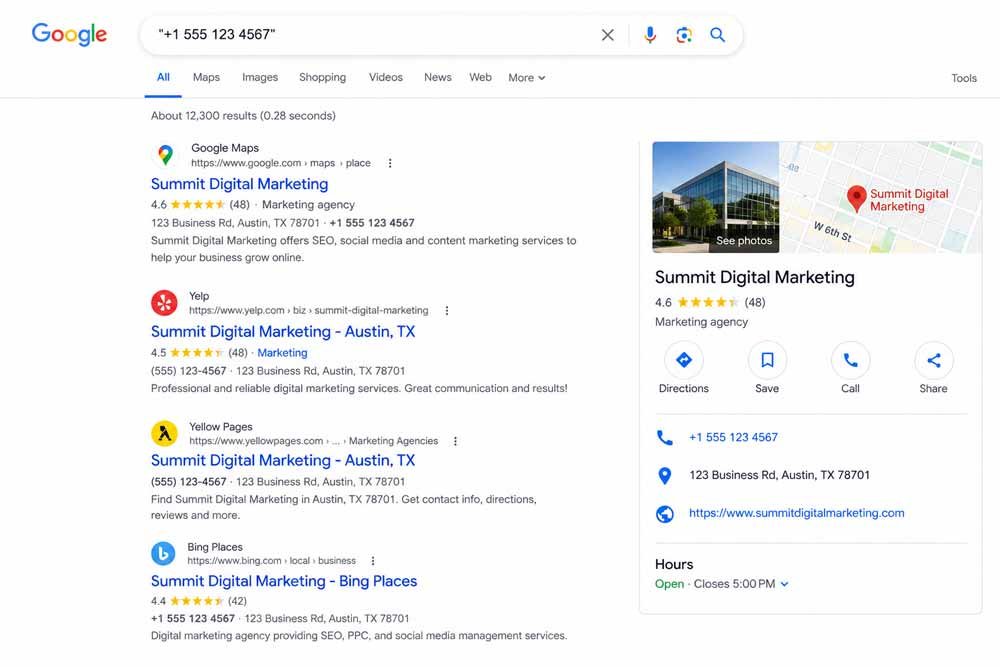
Open a private browser window so your search history does not change the results. Then search for these, one at a time:
- Your phone number in quotes, like “(512) 555-0142”. Then try the other formats of the same number.
- Your old phone numbers and old addresses, in quotes. These find the outdated listings.
- Your street address in quotes.
- Your business name plus your city. Add -site:yourwebsite.com to hide your own site.
- Any older business names you used in the past.
Go through the first few pages of results. Every directory, profile, or article that shows your business is a citation. Write each one down.
Check the big platforms directly
Do not rely on search alone. Log into or search for your business on Google Business Profile, Bing Places, Apple Business Connect, Facebook, and Yelp. Also search your industry’s main directory. Search results can miss listings that are not well indexed, and these platforms are the ones most customers see.
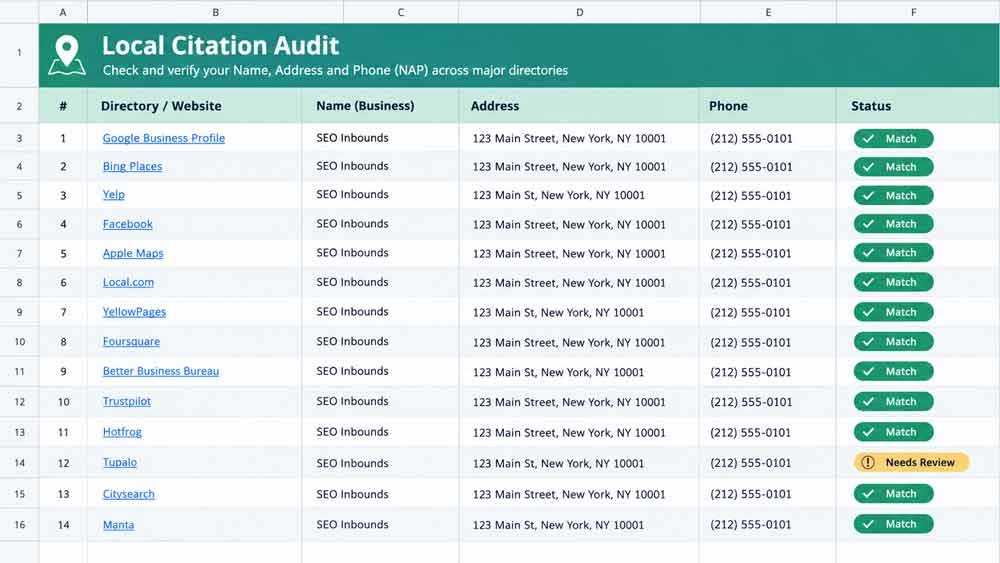
Log everything in a local citation audit spreadsheet
A simple spreadsheet turns a messy search into a clear to-do list. Here is a small example for a made-up business called Sunrise Dental:
Platform | Name shown | Address shown | Phone shown | Match? | Action |
Google Business Profile | Sunrise Dental | 123 Main Street, Suite 200, Austin, TX 78701 | (512) 555-0142 | Yes | None |
Bing Places | Sunrise Dental LLC | 123 Main St, Ste 200, Austin, TX 78701 | 512-555-0142 | Partly | Drop “LLC”, fix format |
Yelp | Sunrise Dental | 88 Oak Avenue, Austin, TX 78702 | (512) 555-0199 | No | Update old address and phone |
Yellow Pages | Sunrise Dental Austin | 123 Main Street #200, Austin TX | (512) 555-0142 | Partly | Drop “Austin”, fix suite |
Sunrise Dental (two pages) | 123 Main Street, Suite 200 | (512) 555-0142 | Duplicate | Merge or remove one page |
Use these columns in your own local citation audit spreadsheet: platform, listing link, name shown, address shown, phone shown, website shown, matches master (yes, partly, no), action needed, who owns the login, date fixed, and date last checked. The “who owns the login” column is more useful than it sounds. A common source of citation problems is not knowing which email address created a listing.
If you already use our link building tracker template, you can copy it and swap the columns for the ones above. The tracking habit is the same, even though the data is different.
How to Fix Inconsistent NAP Without Making It Worse
Once your audit is done, you will have a list of problems. Here is how to fix inconsistent NAP in a sensible order.
- Fix the biggest platforms first. Google Business Profile, Bing, Apple, Facebook, and Yelp reach the most people.
- Claim each listing that is not yet yours. Most directories have a “claim this business” or “own this business” button. You will usually verify by phone, email, or postcard.
- Edit the details to match your canonical NAP exactly. Change the name, address, phone, website, and hours in one go.
- Deal with duplicates. If the same location is listed twice on one platform, look for that platform’s way to merge or remove the extra listing. Do not create a third listing to “replace” the first two.
- Ask for removal if you cannot claim a listing. Many directories have a support form for removing wrong or closed listings.
- Write down what you changed and when. Updates can take days or weeks to show up.
One warning. Some directories get their data from larger data aggregators, which are companies that supply business information to many sites and apps. If you fix a listing but never fix the data upstream, the wrong details can come back later. If a fixed listing keeps reverting, that is often why. Large aggregators have their own business-owner tools, and the lineup changes over time, so check which ones are currently active. Data Axle and Foursquare are two names that often come up.
If you recently moved, changed your phone number, or rebranded, treat the audit as an emergency, not a chore. Old details are the most harmful kind of mismatch, because real customers follow them to the wrong place.
Local Citation Building: Where to Start
After your existing listings are clean, you can think about local citation building, which means adding your business to new places. The goal is not to be listed everywhere. The goal is to be listed correctly in the places that matter to your customers.
For citation building for small business, work through these layers in order:
- Layer 1, the core platforms: Google Business Profile, Bing Places, Apple Business Connect, and Facebook. If these four are right, you have the foundation covered.
- Layer 2, the major directories: Yelp, Yellow Pages, and similar large sites that customers and data feeds actually use.
- Layer 3, your industry: look for directories made for your trade. Lawyers, doctors, restaurants, contractors, and hotels all have niche sites that carry more weight than a generic directory.
- Layer 4, your local area: your Chamber of Commerce, business associations, local news sites, and neighborhood groups.
- Layer 5, unstructured mentions: sponsorships, local press, partner pages, and event listings.
Be picky about generic citation building sites. Thousands of low-quality directories exist, and most add little. Our guides to business listing sites and free directory submission sites explain which general directories are still worth a look and which are a waste of an afternoon.
Be extra careful with paid bulk submission services that promise hundreds of listings for a flat fee. They often create messy duplicates, and some listings cannot be edited later. Slow and accurate beats fast and wide.
Free Local Citation Sites Worth Your Time
You do not need a budget to build a solid base. Here are free local citation sites and platforms that most local businesses should check first. Free tiers and rules change from time to time, so confirm the current terms on each platform before you start.
Platform | Type | Why it is worth your time | Watch out for |
Google Business Profile | Core | The most important local listing you can have. Everything else should match it. | Follow Google’s naming and address rules to avoid suspension |
Bing Places for Business | Core | Feeds Bing search and other apps that use Bing data. | Easy to forget; check the details are not old |
Apple Business Connect | Core | Controls how your business shows in Apple Maps. | Verify ownership so edits stick |
Facebook Business Page | Core / social | Often ranks for your brand name and shows your NAP. | Duplicate pages created by old staff or check-ins |
Yelp | Directory | Strong brand presence and heavy consumer use in many cities. | Do not chase reviews in ways that break Yelp’s rules |
Yellow Pages (YP) | Directory | Long-running directory that feeds other listing sites. | Upsell offers; the basic listing is what you need |
Better Business Bureau | Directory | A trusted name for many buyers. | Accreditation is paid; a basic profile is a separate thing |
Foursquare | Data / app | Its data is used by other apps and maps. | Rules and products change, so check what is current |
After these, add the industry directories and local organizations that fit your business. A plumber should care about a trusted home services directory. A dentist should care about a health provider directory. A café should care about a restaurant guide. Those niche listings tell search engines and customers exactly what you do.
A tip for service-area businesses that travel to customers: Google’s guidelines say service-area businesses should hide their address on their profile, and you cannot use a P.O. box or an unstaffed virtual office as a real location. Whichever version of your address you choose to show elsewhere, keep it consistent, and never invent an address to look local.
Unstructured Citations: Local Mentions That Also Build Backlinks
Structured citations keep your data accurate. Unstructured citations help you look real and well known in your area. A local news story about your shop, a mention on a community blog, or a link from a charity you sponsor all say, “this business exists and people in this town know it.”
Ways to earn them without a PR team:
- Sponsor a local team, event, or charity and ask for a mention on their site.
- Join your Chamber of Commerce or a local business group and use the member directory.
- Share a useful local tip or data point with a local reporter or blogger.
- Partner with nearby businesses and list each other on resource pages.
Many unstructured mentions come with a link back to your site, which makes them local backlinks. Our guides on getting backlinks without guest posting and broken link building both work well for local sites, since local resource pages often have dead links. Keep in mind that many directory links are nofollow, which is fine. The main value of a directory listing is accuracy and visibility, not link power. If that term is new to you, read dofollow vs nofollow backlinks.
How Many Local Citations Do You Need?
The question “how many local citations do I need” has no official answer. Some vendor studies say top local businesses have dozens of consistent citations. Those numbers come from companies that sell citation services, and a business with many citations may simply be an older, more established business. Treat them as a loose benchmark, not a target.
Here is a more useful way to decide. As a starting rule of thumb (my suggestion, not a Google rule), a single-location business can aim for roughly 15 to 25 correct listings: the core platforms, the major directories, two or three industry sites, and a few local ones. After that, check your competition.
Search the phone numbers of the top three businesses in your local results, the same way you searched your own. Note which directories they appear on that you do not. This is a small citation gap analysis, and it works on the same idea as our guide to backlink gap analysis: find where competitors are listed and you are not, then close the gaps that make sense. Stop when new listings stop adding anything new, and put that time into reviews, photos, and local content instead.
Your 30-Day Local SEO Checklist for Citations
This local SEO checklist keeps the work small and steady. Do a little each week instead of one big weekend.
- Days 1–3: Write your canonical NAP. Fix your website footer and contact page to match. Add LocalBusiness schema if you can.
- Days 4–7: Claim and fully fill out your Google Business Profile, Bing Places, and Apple Business Connect listings.
- Days 8–12: Run your citation audit using the Google search methods above and log every listing in your spreadsheet.
- Days 13–20: Fix the wrong listings, starting with old addresses, old phone numbers, and duplicates.
- Days 21–26: Add your business to two or three industry directories and your local Chamber of Commerce or business group.
- Days 27–30: Reach out for one or two unstructured mentions, such as a sponsorship or a local partner page. Then re-check the listings you fixed.
- Every three months: repeat a short audit and update anything that changed.
Common Local Citation Mistakes
- Using a P.O. box, a mail drop, or a virtual office as your address. Google’s rules do not allow it for profiles, and it can get a profile suspended.
- Stuffing keywords or city names into the business name. Some ranking surveys list keywords in the profile name as a strong signal, but Google’s guidelines say not to do it, and it is a common reason for suspensions.
- Putting a call-tracking number as the main phone on every listing. Keep your main local number as the primary one, and use tracking numbers only where a platform allows a secondary number.
- Creating a new listing when you cannot log into the old one. This is how duplicates are born.
- Forgetting to update listings after a move, a rebrand, or a phone change.
- Buying bulk submissions from services that cannot show you the logins to the listings they made.
- Treating your local citations audit as a one-time job. Data drifts, staff change, and directories add new profiles on their own.
How to Track and Maintain Your Citations
Clean local citations do not stay clean by themselves. Aggregators refresh data, customers suggest edits, and old owners of a listing can reappear. Keep the upkeep light and regular.
- Run a short audit every three months with the same Google searches and the same spreadsheet.
- Set a free Google Alert for your phone number and your business name, so new mentions reach your inbox.
- Keep a shared record of which email account owns which listing, so a staff change never locks you out.
- Update your canonical NAP sheet first whenever anything changes, then update the listings one by one.
If you also build links, your backlinks and citations will often show up in the same reports. Our list of free backlink checker tools can show you which local sites are linking to you.
Where Local Citations Fit in Your Off-Page SEO Strategy
Local citations are one part of off-page work, not the whole thing. If you are new to the topic, start with what off-page SEO is, then use our off-page SEO checklist and our plan to build backlinks for free to cover the rest. Local citations give you accuracy and trust. Backlinks and mentions give you authority. Reviews give you proof. Each one supports the others.
The honest summary: local citations will not rescue a weak Google Business Profile or a business with no reviews. But clean, consistent listings remove a quiet source of confusion, protect you from losing customers to old details, and help AI tools describe your business correctly. For most local businesses, one focused month of work is enough to get there.
FAQ
What is NAP in local SEO?
NAP stands for name, address, and phone number. It is the basic contact information for a local business. In local SEO, the goal is to show the same NAP everywhere your business is listed online.
Do local citations still matter in 2026?
Yes, local citations still matter, but less for rankings than Google Business Profile signals and reviews. Expert surveys put citation signals at a small share of local pack ranking weight, around 6 to 7 percent. They still matter for accuracy, customer trust, and how AI tools describe your business.
How many local citations do I need?
There is no fixed number. A single-location business can start with the core platforms, the major directories, a few industry sites, and a few local ones, which is often around 15 to 25 listings. Check the top three competitors in your area and close any gaps that make sense.
How do I check NAP consistency for free?
To audit your local citations, search your phone number, old phone numbers, address, and business name in quotes on Google, then check the big platforms directly. Log what you find in a spreadsheet and compare each listing with your canonical NAP. You do not need a paid tool for a single location.
How do I fix inconsistent NAP?
Claim each wrong listing, update the details to match your master record, and remove or merge duplicates. Start with the biggest platforms. If a corrected listing changes back, the wrong data may be coming from a data aggregator, and you will need to fix it there too.
Are local citations the same as backlinks?
No. A citation is a mention of your business details, with or without a link. A backlink is a link to your website. Some citations also include a link, so they can overlap, but many directory links are nofollow and mainly help accuracy and visibility.
How long do citation fixes take to show up?
Some platforms update within a day or two. Others take several weeks, especially when changes pass through data aggregators. Write down the date you made each change and re-check after about a month.
Do I need local citations if my business is online only?
Less so. Google Business Profiles are for businesses that meet customers in person, so an online-only business is usually not eligible. Brand mentions and listings on relevant industry sites still help, but the address-based part of this guide will not apply.
Should I pay for a citation building service?
Usually not for a single location. The core work is free and takes a few hours. A paid tool can help if you manage many locations or want automatic monitoring, but avoid cheap bulk submission services that cannot show you the listings they created.