
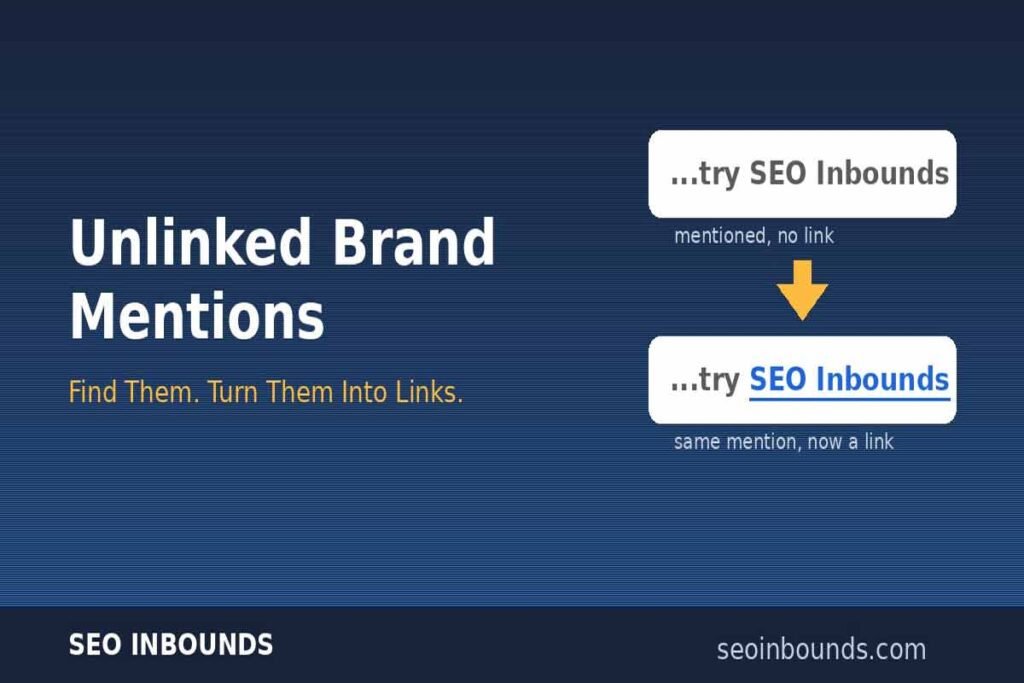
Someone already wrote about you. They said your name, praised your guide, or quoted your tool. They just forgot to link to you. That is an unlinked brand mention, and it is one of the easiest link opportunities you will ever find, because the hard part (getting noticed) is already done.
Here is the honest version before we start. Turning unlinked brand mentions into backlinks is not magic, and it does not work every time. Plenty of writers will not reply, and some sites will not edit old posts. But the people you are writing to already know your brand, so this tends to work better than cold outreach, and it costs nothing but time.
This guide shows you how to find unlinked mentions for free, how to decide which ones are worth your effort, and how to write a short email that gets a yes.
It also covers link reclamation, the bigger idea behind all of this, and the free brand monitoring tools that keep the whole process running.
What Are Unlinked Brand Mentions?
An unlinked brand mention is any place on the web where your brand name appears as plain text, with no clickable link to your website. You will also see this called an unlinked mention. A normal mention looks like this: “I use SEO Inbounds for link building tips.” A linked mention turns “SEO Inbounds” into a clickable link to your site.
Brand mentions come in several forms. Your company name is the obvious one, but they also include your product names, the names of people on your team, the title of a report you published, or the name of a free tool you made. Misspellings count too, since writers are not always careful.
Unlinked mentions usually appear because the writer was busy, because the platform made linking hard, or because they simply did not think of it. It is rarely personal, and that is why a polite message works so often.
Brand Mentions and SEO: Do Unlinked Mentions Actually Help?
This part deserves a straight answer, because a lot of articles oversell it. Google has not confirmed that it counts unlinked mentions as a direct ranking signal.
According to SEO publications that reported his comments, Google’s John Mueller has said unlinked mentions are not treated like links for ranking. So an unlinked brand mention on its own should not be expected to move your rankings.
So why bother? Three reasons:
- A link is a real, countable signal. Turning a mention into a link gives you something search engines can follow, plus readers who may click through.
- Brand mentions still help people and tools find you. They build familiarity, and branded searches often follow.
- Mentions seem to matter for AI search. One Ahrefs analysis, as summarized by other SEO sites, found that unlinked web mentions were more strongly connected to appearing in Google’s AI Overviews than backlinks were. That is a correlation, not proof of cause, but it fits the wider trend.
That last point ties into topics covered elsewhere on this site. If you want the bigger picture, read our guides on generative engine optimization and Google AI Overviews SEO. The short version: being named in the right places helps you, and being linked makes it count for more.
Mentions also build up in places you do not control. Community threads are one example, which we cover in our Reddit SEO guide. Local business listings are another, since they work like unstructured mentions of your name and address. Our guide to local citations explains that side.
Link Reclamation: The Bigger Picture
Link reclamation means winning back links you earned, or should have earned, but are not getting credit for. Unlinked brand mentions are the most popular type, but they are only one piece. Here are the five kinds of link reclamation worth knowing about:
What you are reclaiming | How to find it | How to fix it |
Your brand name, mentioned without a link | Google search operators, Google Alerts | Ask the writer to link the name to your homepage or the right page |
A product, tool, report, or person you own | Search the exact name in quotes, minus your own site | Ask for a link to the page about that product, tool, or report |
Your image, chart, or infographic used without credit | Reverse image search (Google Lens or TinEye) | Ask for a credit link next to the image |
A link to your site that now shows a 404 | Search Console Links report, free backlink checker | Add a 301 redirect from the old URL to the closest live page |
A link that points to the wrong page of your site | Spot-check top referring pages | Ask the owner to swap the URL, or redirect if that is not possible |
The broken-link row is worth a quick note. If you change a URL or delete a page, any links pointing at the old address stop helping you. A free backlink checker can show which dead pages still have links.
Add a 301 redirect to the closest live page and you recover most of that value. This is the mirror image of broken link building, where you fix other sites’ broken links. Here, you are fixing your own.
How to Find Unlinked Mentions (Free Methods)
If you are wondering how to find unlinked mentions of your brand for free, you have three solid starting points: Google search operators, Google Alerts, and a few free helpers. Together they cover most small and medium sites.
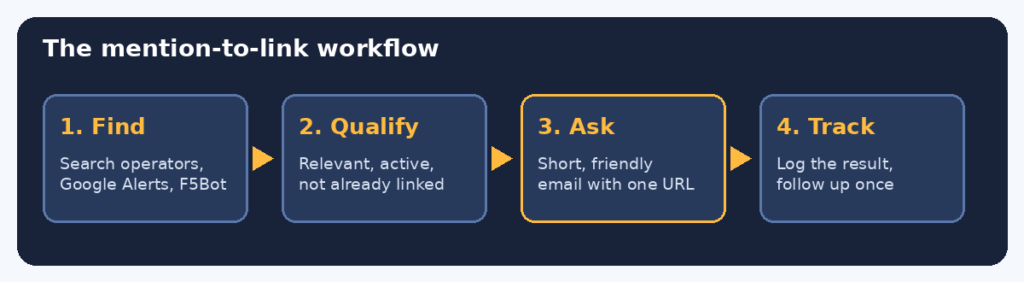
Step 1: List the names to search for
Before you search, write down every name people might use for you:
- Your brand name, in its usual form and any common short form.
- Common misspellings, and the name with or without spaces.
- Your domain name written as plain text, like seoinbounds.com.
- Product, tool, and report names you own.
- The names of founders or public-facing team members.
Step 2: Use Google search operators
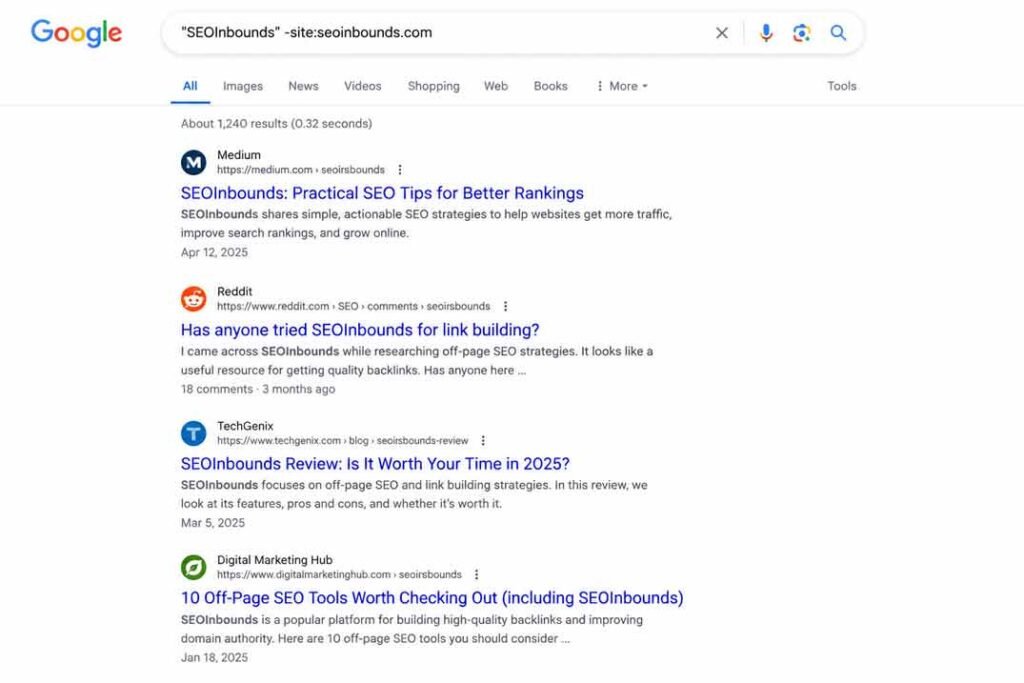
Search operators are special characters that make Google more precise. The simplest unlinked mention search is to look for your brand name in quotes and remove your own site from the results:
“SEO Inbounds” -site:seoinbounds.com
The quotes tell Google to look for the exact phrase. The minus sign and site: part tell Google to leave out your own website. You can add more exclusions to hide your own social pages, such as -site:facebook.com or -site:linkedin.com. To narrow results to a topic, add a keyword:
“SEO Inbounds” “backlink gap analysis” -site:seoinbounds.com
To catch mentions of your domain as plain text, search the domain itself in quotes, minus your site. You can also limit results to the past year using the Tools menu under the search bar. Run these searches once a month. They find older and newly published mentions that alerts miss.
Step 3: Set up Google Alerts
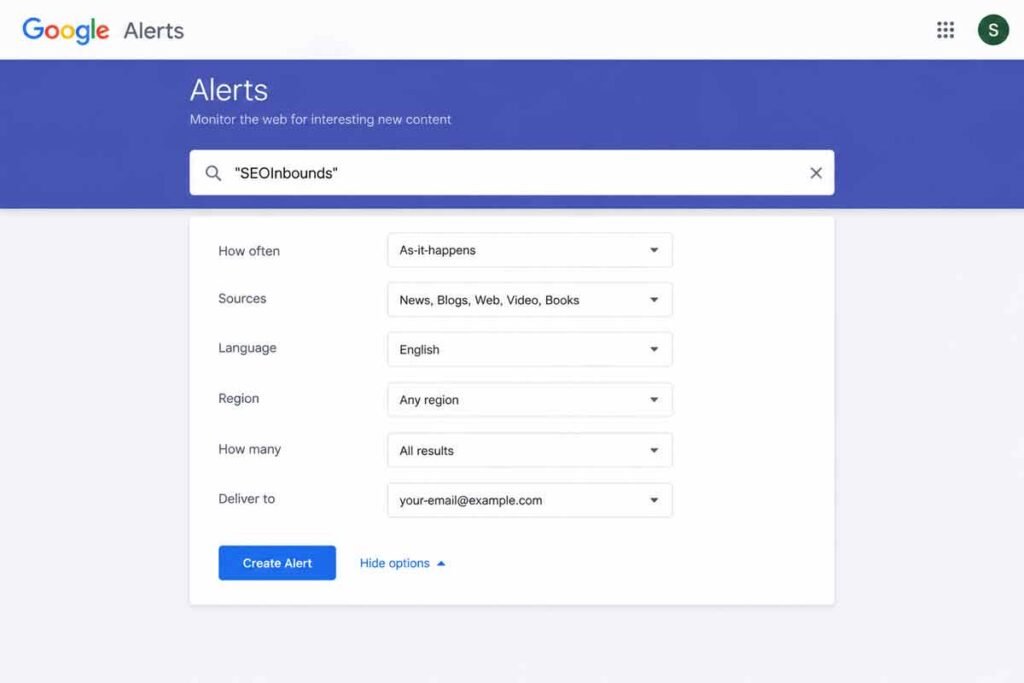
Google Alerts is free and sends you an email when new pages matching your search appear. Go to Google Alerts, type your brand name in quotes, and click Show options. Choose how often you want emails, which sources to include, your language and region, and whether you want only the best results. Then create one alert for each name on your list.
Be realistic about it. Google Alerts is a good free start, but it does not catch everything, and it cannot tell you whether a page already links to you. Treat it as a smoke detector, not a full audit.
Step 4: Add free helpers
F5Bot is a free tool that emails you when your chosen keywords appear on Reddit, Hacker News, or Lobsters. It is a nice fit if your audience hangs out on those sites. Read more at F5Bot. For checking who already links to you, use the Links report in Google Search Console, and consider Ahrefs Webmaster Tools, which is free for sites you own and shows which pages link to you.
Step 5: Search for your images and quotes
If you publish original charts, screenshots, or infographics, other sites may use them without a link. Right-click the image and search for it with Google Lens, or upload it to TinEye, to find where else it appears. If a site used your image without credit, a link back is a fair and easy request.
How to check if a mention already has a link
Before you contact anyone, make sure the link is really missing. Open the page, press Ctrl+F (or Cmd+F on a Mac), and type your brand name. Hover over it.
If it is a link, your browser will show the destination at the bottom of the screen. Some pages link your name to your social profile instead of your site, which is still worth fixing.
Brand Mention Monitoring: Free Brand Monitoring Tools Compared
Brand mention monitoring simply means checking for new mentions on a regular schedule, instead of once. It does not need a big budget. Here is how the free brand monitoring tools compare with paid options:
Tool or method | Cost | Best for | Limits |
Google search operators | Free | Finding older mentions already indexed | Manual; results change; no alerts |
Google Alerts | Free | New mentions sent to your email | Does not catch everything and cannot filter by quality |
F5Bot | Free | Mentions on Reddit, Hacker News, and Lobsters | Narrow; covers only those sites |
Google Search Console | Free | Seeing which sites already link to you | Shows links, not unlinked mentions |
Ahrefs Webmaster Tools | Free for your own verified site | Listing your referring pages so you can exclude them | Shows who links to you; it is not a mention finder |
Paid brand monitoring tools | Paid (trials vary) | Wider coverage, filtering, and exports across the web | Plans and prices change, so check before you buy |
Paid tools like Brand24, Mention, Semrush’s brand monitoring, and Ahrefs’ alert features cover more of the web, filter out junk, and let you export lists. They become worth a look when you get dozens of mentions a month and manual checking starts to eat your week. Some offer free trials, but plans and prices change, so check current terms before you sign up.
For a small site, a simple routine is enough: Google Alerts running all the time, one operator search a month, and F5Bot if Reddit matters in your niche.
Which Unlinked Brand Mentions Are Worth Chasing?
Not every mention deserves an email. Spending an hour on a spammy scraper site will not help you. Use this quick checklist to decide where to put your effort:
Check | Good sign | Skip it if |
Relevance | The page covers your topic or industry | The page has nothing to do with what you do |
Quality | Real content, real readers, editorial standards | Scraped, spun, or auto-generated text |
Activity | Updated or published in the last 12 to 18 months | Dead site with no recent posts |
Context | Positive or neutral mention, clear spot for a link | A complaint, a negative review, or a throwaway mention |
Editability | A blog or roundup the owner controls | A news archive that rarely changes published stories |
Existing link | Your name appears with no link or links to the wrong place | It already links to you correctly |
A good rule: if the page would look fine linked to your site in a screenshot, it is worth a message. If you would feel uncomfortable showing it to a customer, skip it.
Put the best candidates at the top. Relevant blogs, industry roundups, resource pages, and “best of” lists tend to be the easiest to convert, because the owner already cares about linking out to useful things.
How to Turn Unlinked Brand Mentions Into Backlinks
Now for the part people worry about: the email. The secret is to keep it short, friendly, and specific. You are not asking for a favor from a stranger. You are thanking someone and making their post slightly better for readers.
A simple outreach email template
Subject: Thanks for mentioning [Brand] in “[Post title]”
Hi [Name],
I just read your post “[Post title]” and saw you mentioned
[Brand] in the section on [topic]. Thank you, I really
appreciate it.
If you have a minute, would you mind linking the mention to
[URL]? It would help readers who want to see the [guide/tool]
you described.
Thanks again,
[Your name]
A template for a link that points to the wrong page
Subject: Quick fix for a link in “[Post title]”
Hi [Name],
Thanks for linking to us in “[Post title]”. I noticed the
link goes to our homepage, but the page you describe is
actually here: [URL]. Would you mind swapping it?
Thanks so much,
[Your name]
Rules that raise your reply rate
- Keep it under about 100 words. Busy people reply to short emails.
- Name the exact post and the exact spot where your brand appears. It proves you are not sending a mass email.
- Give one clear URL. Do not make the writer choose between several pages.
- Do not mention SEO, backlinks, or rankings. Say that the link helps readers.
- Send one polite follow-up after about a week, then move on.
Do not dictate the anchor text. Asking someone to use a specific keyword phrase makes the request feel like a favor for search engines, and it can create the kind of pattern our guide on anchor text warns about. Your brand name or the page title is a natural choice, and it is usually what they already wrote.
Find the right contact, too. For a personal blog, the author is the person to ask. For a company site or publication, look for the writer’s byline first, then the editor or a contact page. Avoid sending the same email to several people at one site.
What Success Rates Should You Expect?
You will see big numbers quoted online. Many sites that sell monitoring tools say unlinked mention outreach converts at 15 to 40 percent or higher, compared with a few percent for cold outreach. Treat those figures as optimistic. Some of the larger claims are repeated across many articles without a primary study behind them.
A more useful way to think about it: mentions convert better than cold emails because the writer already knows and named your brand, but results depend heavily on which mentions you pick and how you write. Blogs and roundups tend to say yes more often. News sites often refuse to edit published stories, and that is normal.
The honest approach is to measure your own results. Keep a record of every email, reply, and live link. If you already use our link building tracker template, you can add a column for the mention URL and a column for whether a link already existed. After 20 or 30 emails, you will know your real conversion rate, which is worth more than any published average.
How to Track and Repeat the Process
Unlinked mentions keep appearing as you publish and get noticed, so build a light routine around it. A simple monthly cycle is enough:
- Run your operator searches and check your Google Alerts emails.
- Log every new mention in your tracker with the date, the page, and whether it links.
- Score each mention with the checklist above and pick the top few.
- Send your emails, then follow up once after about a week.
- Note which links went live, which pages replied, and what you would change next time.
Also check that the page with your new link is indexed. A link on a page Google has not crawled does very little. Over time, you will see which kinds of sites reply, and you can spend your time on those first.
Common Mistakes With Unlinked Brand Mentions
- Emailing every mention you find, including spam and scraped pages.
- Sending a copy-and-paste email with no mention of the specific post.
- Asking for an exact keyword as the anchor text, instead of your brand name.
- Skipping the check for an existing link, then asking for something that is already there.
- Chasing negative or off-topic mentions, which can create awkward conversations and little value.
- Following up again and again. One polite nudge is enough.
- Forgetting misspellings, so you miss mentions that use a variant of your name.
- Forgetting your own broken links. Reclaiming a dead URL with a 301 redirect is often quicker than any outreach.
- Stuffing keyword-rich links into press releases or guest posts you distribute yourself, which is a different matter from reclaiming genuine mentions.
Where Unlinked Brand Mentions Fit in Your Off-Page SEO Strategy
Reclaiming unlinked brand mentions works best as one part of a wider plan. Pair it with a backlink gap analysis to find where competitors are linked, and with the tactics in our guide to getting backlinks without guest posting. If you are new to the topic, start with what off-page SEO is, then work through our off-page SEO checklist and the plan to build backlinks for free.
If a link you win is paid or sponsored, or sits in a comment or forum, it may be nofollow, which is normal. Our guide to dofollow vs nofollow backlinks explains what that means for you.
The honest summary: unlinked brand mentions will not transform a site overnight. But they are a low-cost, low-risk way to turn work you have already done into links you can count. Set up your alerts, check once a month, and write one good email at a time.
FAQ
What are unlinked brand mentions?
They are places on the web where your brand name, product, or content is mentioned as plain text with no link to your website. They are easy link opportunities because the writer already knows about you.
Do unlinked brand mentions help SEO?
Not directly, as far as Google has said. They do not work like links for ranking. But turning a mention into a link gives you a real backlink and possible referral traffic, and mentions may help with brand visibility and AI search.
How do I find unlinked mentions for free?
Search your brand name in quotes with your own site excluded, like “Your Brand” -site:yourdomain.com. Set up Google Alerts for new mentions, and use F5Bot if Reddit matters to you. Then check each result to see whether it already links to you.
What is link reclamation?
Link reclamation is winning back links you earned or should have earned. It includes unlinked brand mentions, unlinked image use, links to pages that now show a 404, and links that point to the wrong page.
How do I set up Google Alerts for brand mentions?
Go to Google Alerts, type your brand name in quotes, and open the options to choose how often you get emails, the sources, language, and region. Create separate alerts for misspellings, product names, and your domain.
What conversion rate should I expect from outreach?
There is no reliable neutral figure. Tool vendors often quote 15 to 40 percent or more, but treat that as optimistic. Track your own results. Mentions usually convert better than cold outreach, but success depends on picking relevant, editable pages.
How do I ask for a link without being pushy?
Thank the writer, name the exact post, offer one URL, and explain that it helps readers. Keep the email short, skip the SEO talk, and send only one follow-up.
Should I ask for a specific anchor text?
No. Let the writer keep their own wording, which is usually your brand name. Asking for a keyword phrase makes the link look arranged and can create an unnatural pattern.
Are free brand monitoring tools enough?
For most small sites, yes. Google Alerts, monthly search operators, and a free tool like F5Bot cover a lot. Paid tools help when you get many mentions each month or want filtering and exports.
How often should I check for new mentions?
Let Google Alerts run all the time, and do a manual operator search once a month. Review and email your best candidates on a regular schedule, then re-check results every few months.

Unlinked brand mentions can be valuable backlink opportunities because the website has already acknowledged the brand. Before reaching out, check whether the mention appears in a relevant context and identify the most useful page to link to. A personalized, polite request is usually more effective than a generic outreach email.