Here is the part most beginner SEO guides skip: writing good content is not enough to rank on Google. A perfectly optimized article with no external authority behind it will get outranked by a weaker article that has real backlinks, brand mentions, and trust signals pointing at it.
That external authority is what off-page SEO builds. In 2026, it matters more than ever because Google now factors in E-E-A-T (Experience, Expertise, Authoritativeness, Trustworthiness) as a core quality signal. Off-page SEO is how you prove those things to Google without just saying them yourself.
This guide covers everything a beginner needs to know: what off-page SEO actually is, how it differs from on-page SEO, the 7 pillars that drive rankings in 2026, and a complete free checklist to start today.
This is the pillar guide for the seoinbounds.com off-page SEO content cluster. The specific free techniques here link to full step-by-step guides for each tactic: article submission, blog submission, backlink submission, and URL submission all free.
What Is Off-Page SEO? (The Plain-English Definition)
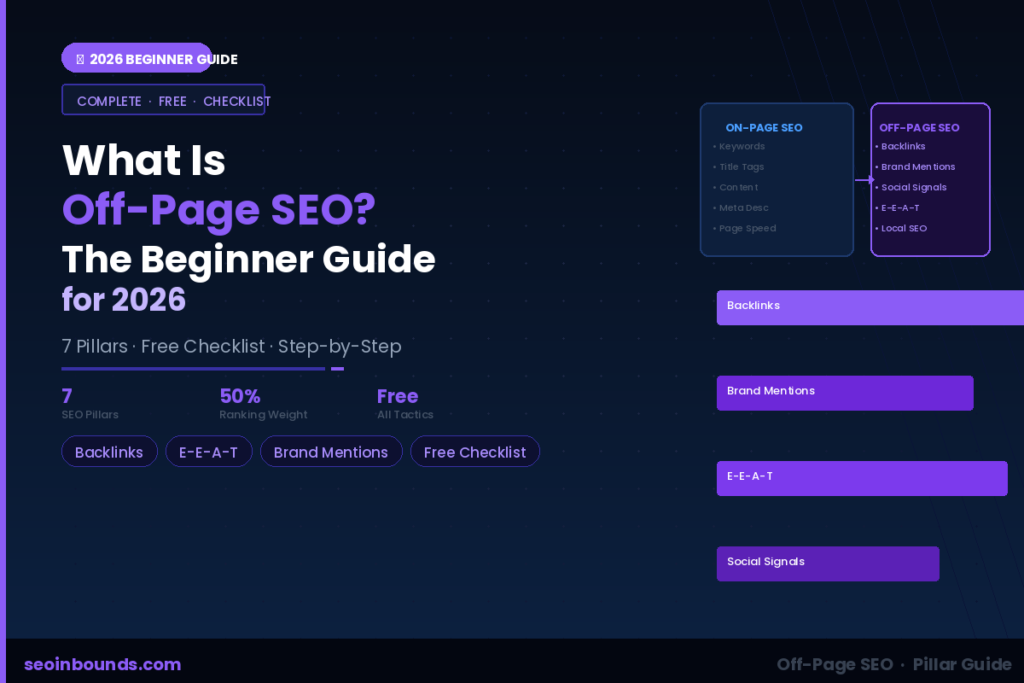
Off-page SEO is everything you do outside your own website to improve where it ranks in search results. It is the opposite of on-page SEO, which covers everything inside your website content, keyword usage, title tags, internal links.
Think of it this way: on-page SEO tells Google what your site is about. Off-page SEO tells Google how much the rest of the internet trusts your site.
Google has always understood that any website can claim to be an authority. What it cannot fake is what other websites, publications, and communities say about it. When authoritative sites link to you, mention your brand, or share your content, those are third-party trust signals that Google weighs heavily in its ranking algorithm.
| Off-Page Signal | What It Tells Google | Example |
| Backlink from DA 80+ site | This site is trusted by a credible source | Medium article linking to your post |
| Unlinked brand mention | People know and reference your brand | Forbes article mentioning your company by name |
| Social shares | Content is being distributed and engaged with | LinkedIn post with 200+ shares linking to your article |
| Local directory listing | Your business exists in the real world | Google Business Profile, Yelp listing |
| Guest post on authority site | A credible platform vouches for your expertise | Article published on Entrepreneur.com |
Why Off-Page SEO Matters More Than Most Beginners Realize
Research from Moz consistently shows off-page signals account for roughly 50% of Google ranking factors. On-page SEO handles the other half. In practice: if two competing pages have similar content quality, the one with stronger off-page authority wins almost every time.
In 2026, this matters even more because of two developments.
- Google AI Overviews: The pages that appear in Google’s AI-generated summaries are the same pages ranking highly in traditional organic search. LLMs like ChatGPT and Perplexity also pull from ranked, authoritative sources. Off-page SEO now affects your visibility in AI-generated answers too.
- E-E-A-T signals: Google’s Quality Rater Guidelines instruct evaluators to look beyond what a website claims about itself and assess what others say about it. That external reputation is built almost entirely through off-page SEO activities.
A new site with zero off-page authority will struggle to rank for any competitive keyword regardless of how well the content is written. Off-page SEO is not optional it is the fuel that makes your content visible.
On-Page SEO vs Off-Page SEO: What Is the Difference?
These two work together but cover completely different ground. Understanding the difference stops you from optimizing the wrong thing when your real problem is in the other camp.
| Factor | On-Page SEO | Off-Page SEO |
| Location | Inside your website | Outside your website |
| What you control | Directly and completely | Indirectly you earn it |
| Main signals | Content, keywords, title tags, internal links | Backlinks, brand mentions, social signals |
| How fast it works | Days to weeks after publishing | Weeks to months after building |
| Free to do? | Yes always | Yes with the right strategy |
| Primary tool | Rank Math, Google Search Console | MozBar, Ahrefs free, Google Alerts |
You need both. On-page SEO without off-page authority makes content invisible. Off-page SEO without solid on-page foundations wastes the authority you build. Neither works well alone.
The 7 Pillars of Off-Page SEO in 2026
Off-page SEO is not just link building. It covers seven distinct signal types that Google uses to assess authority, trustworthiness, and relevance.
| Pillar | What It Is | Impact Level |
| 1. Backlinks | Links from external websites to your pages | Very High |
| 2. Brand Mentions | References to your brand online, linked or unlinked | High |
| 3. E-E-A-T Signals | Proof of Experience, Expertise, Authority, Trust | High |
| 4. Social Signals | Shares, engagement, discussion on social platforms | Medium |
| 5. Local SEO | Business listings, citations, Google Business Profile | High (local sites) |
| 6. Content Distribution | Publishing on external platforms for new audiences | Medium-High |
| 7. Digital PR | Mentions in news, publications, authority media | Very High |
Backlinks: The Most Important Off-Page SEO Signal
A backlink is a link from another website that points to a page on your site. Every quality backlink is a vote of trust. Google weighs these votes by the authority of the linking domain to determine how much trust to assign your pages.
Not all backlinks are equal. A single link from a DA 90 publication carries more weight than 500 links from DA 5 directories. Quality beats quantity every time, and Google’s Penguin filter penalizes unnatural or spammy link profiles.
Once you start building links, don’t just assume they’re working, these free backlink checker tools show you exactly what’s live, indexed, and passing value.
What Makes a Backlink High Quality?
- High Domain Authority (DA 40+): The higher the DA of the linking domain, the more authority it transfers to your page.
- Topical relevance: A link from an SEO blog to an SEO guide carries more weight than a link from an unrelated cooking site.
- Dofollow: Dofollow links pass link equity directly. Nofollow links do not pass equity but contribute to a natural profile and drive real traffic.
- Editorial placement: A link placed naturally within the body of a real article is worth far more than one in a footer or sidebar.
- Anchor text variation: Natural link profiles use varied anchors 80% branded or neutral, only 20% keyword-rich.
For editorial links, start with this free guest posting sites guide.
| Backlink Tier | DA Range | SEO Value | Examples |
| Tier 1 editorial | 70-98 | Very High | Medium, LinkedIn, HubPages, EzineArticles |
| Tier 2 directory | 50-69 | High | Blogarama, BizSugar, ArticleBiz |
| Tier 3 supporting | 30-49 | Medium | Niche directories, blog communities |
| Tier 4 low DA | Under 30 | Minimal | Avoid near zero value |
For a complete step-by-step guide to building backlinks using free platforms, the free backlink submission sites guide covers 100+ verified platforms organized by DA tier and link type.
Brand Mentions and E-E-A-T: The Signal Most Beginners Ignore
Google’s Quality Rater Guidelines use E-E-A-T: Experience, Expertise, Authoritativeness, and Trustworthiness. Your on-page content demonstrates expertise. Your off-page presence demonstrates authority and trustworthiness.
Brand mentions even without a link contribute to your off-page authority. When Google sees your brand name referenced on credible sites, that pattern builds what Google calls your “reputation.” For YMYL topics like health, finance, and legal content, this signal is a direct ranking factor.
How to Build Brand Mentions as a Beginner
- Publish original research or case studies that other sites want to reference
- Create a consistent author profile across Medium, LinkedIn, Quora, and HackerNoon
- Answer niche questions on Quora and Reddit with genuine expertise
- Contribute to expert roundup posts where editors quote multiple voices
- Submit articles to high-authority platforms where your byline appears publicly
Article submission on high-DA platforms is one of the fastest ways to build visible E-E-A-T signals. The 200+ free article submission sites guide covers which platforms show author bylines publicly and how to optimize profiles for maximum credibility.
Social Signals: Do They Actually Affect SEO?
The honest answer is: indirectly, yes. Google has officially stated that social shares are not a direct ranking factor. But the indirect effects are real.
- Content amplification: A LinkedIn post with 500 shares drives traffic to your article. That traffic generates engagement signals time on page, return visits that Google does factor into rankings.
- Faster discovery: Social platforms are crawled constantly. A link to your article on LinkedIn or Twitter can result in Google indexing that page within hours.
- Backlink triggers: Viral social content attracts editorial backlinks from bloggers and journalists who see it. The backlinks are the ranking signal. Social reach is what triggers them.
Share every piece of content you publish on LinkedIn, Twitter/X, and any niche community. Not because social signals rank you directly, but because they accelerate discovery, drive traffic, and occasionally trigger the backlinks that do.
Use social bookmarking sites for faster discovery and referral traffic.
Read complete guide on Discovered vs Crawled – Currently Not Indexed
How to Do Off-Page SEO for Free (Step-by-Step)
Here is the exact free off-page SEO strategy for a new site in 2026, ordered from highest impact to lowest. Every tactic uses free tools and free platforms.
Step 1: Submit Your URL to Search Engines First
Before anything else, make sure Google and Bing can find your site. Submit your sitemap and request indexing for your most important pages.
The complete guide is at: Free URL Submission to Search Engines in 2026
Step 2: Build Your First 20 Backlinks from Tier 1 Platforms
Start with the highest-DA free platforms: Medium (DA 95), LinkedIn Articles (DA 98), HubPages (DA 90), Blogger (DA 89), and Tumblr (DA 93). Publish original content on each with a natural backlink to your site. These are covered in the Web 2.0 submission sites guide.
Build 3 to 5 links per week across varied platform types. A natural-looking link profile grows gradually, not overnight.
Full platform list: 100+ Free Backlink Submission Sites for 2026
Step 3: Submit Your Blog to High-DA Directories
Blog directories like Blogarama (DA 72), AllTop (DA 80), For general, niche, and local listings, use the free directory submission sites guide and Bloglovin (DA 79) list your blog for ongoing discovery. New posts get auto-syndicated via RSS. This is passive SEO that requires zero ongoing effort after setup.
Complete guide: 100+ Free Blog Submission Sites for SEO in 2026
Step 4: Submit Articles to High-DA Article Directories
EzineArticles (DA 70), ArticleBiz (DA 68), HubPages (DA 90), and SelfGrowth (DA 65) all accept free article submissions with in-content dofollow links. Write 800 to 1,200 word original pieces targeting keywords your main site also covers but from different angles.
Complete guide with 200+ platforms: 200+ Free Article Submission Sites for 2026
Step 5: Create Author Profiles on Community Platforms
Create complete profiles on Quora, Reddit, LinkedIn, GitHub, About.me, and Crunchbase. Fill in your bio with your target keyword naturally. Add your site URL. These are permanent branded links from trusted domains that take 20 minutes each.
Step 6: Answer Questions on Quora and Reddit
Find questions in your niche with high view counts. Write genuine 300 to 500 word answers. Link to your detailed guides only where it adds real value. Do not drop links in every answer.
Step 7: Track Everything Monthly
In Google Search Console, check your Links report monthly. See which domains link to you, which pages have the most backlinks, and whether new submissions have been indexed.
| Month | Focus | Goal |
| Month 1 | Tier 1 Web 2.0 + sitemap submission | 10-15 foundation backlinks from DA 80+ |
| Month 2 | Article directories + blog directories | 20-30 additional supporting links |
| Month 3 | Profile creation + community platforms | Brand signals + 10-15 more links |
| Month 4+ | Consistent publishing + track and optimize | 8-12 new links per month ongoing |
Off-Page SEO Tools That Are Free in 2026
| Tool | What It Does | Free Limit |
| Google Search Console | Backlinks, indexed pages, crawl errors, performance data | Unlimited fully free |
| MozBar (Chrome) | Checks DA/PA of any site as you browse | Free unlimited checks |
| Ahrefs Free Backlink Checker | Shows top 100 backlinks to any URL | 1 check per domain free |
| Ubersuggest | Keyword difficulty, competitor backlink data | 3 free searches/day |
| Google Alerts | Monitors brand mentions across the web in real time | Fully free |
| SimilarWeb Free | Traffic estimates for submission platforms | Free basic data |
| Hunter.io | Finds contact emails for link outreach | 25 free searches/month |
If your site runs on WordPress, these free SEO tools for WordPress can help track indexing, rankings, and technical issues alongside off-page work.
How Long Does Off-Page SEO Take to Work?
Off-page SEO does not produce overnight results. The timeline depends on your site’s current authority, the quality of links you build, and how competitive your target keywords are.
| Activity | Timeline | What Speeds It Up |
| First backlinks indexed | 3-14 days | Submit via GSC, high-DA platform |
| Referral traffic from submissions | 1-4 weeks | Strong content, DA 70+ platform |
| Keyword ranking movement (low KD) | 4-8 weeks | 10+ quality backlinks, solid on-page |
| Domain Authority increase | 3-6 months | Consistent 8-12 links/month from DA 50+ |
| Medium competition keywords | 6-12 months | Combined backlink and content strategy |
| Topical authority recognition | 6-18 months | 5+ articles covering same niche topic |
Ten links per month for twelve months outperforms sixty links in one week every single time. Google rewards sites that grow their authority naturally and consistently.
Off-Page SEO Mistakes Beginners Make (And How to Avoid Them)
1. Building Links Before Fixing On-Page Basics
If your pages have noindex tags, slow load times, or thin content, backlinks will not save them. Fix your technical and on-page foundation first. Then build off-page authority on top of it.
2. Mass Submissions to Low-DA Directories
Submitting to 300 DA 10 directories achieves nothing. Twenty links from DA 60+ platforms beats 500 links from DA 10 sites by a margin that is not close. Always filter by DA before submitting anywhere.
3. Using the Same Anchor Text for Every Backlink
If every backlink uses the exact phrase “off-page SEO guide,” Google flags it as manipulation. 80% of your anchors should be branded, your URL, or neutral phrases. Only 20% keyword-rich.
4. Never Checking Whether Links Got Indexed
An unindexed backlink page has zero SEO value. Check your GSC Links report monthly. Use site:platformdomain.com “yourbrandname” to confirm listed pages are visible in Google.
5. Expecting Results in Two Weeks
Off-page SEO is a 3 to 12 month strategy minimum. Set realistic expectations, track monthly, and stay consistent.
Never pay for backlinks. Paid links violate Google’s Webmaster Guidelines and can result in a manual penalty that removes your entire site from search results. Every free method in this guide is safe, legitimate, and sustainable.
Quick Off-Page SEO Workflow
A basic off-page SEO workflow starts with technical readiness, then moves into brand profiles, citations, backlinks, content promotion, and monthly monitoring.
Start with these essentials:
- Verify your site in Google Search Console.
- Submit your XML sitemap.
- Fix internal links to the pages you want to promote.
- Build real brand profiles and citations.
- Earn relevant backlinks from trusted sources.
- Promote new content through communities and repurposed assets.
- Track links, mentions, impressions, and referral traffic monthly.
For the complete task-by-task version, use our Off-Page SEO Checklist 2026.
Frequently Asked Questions
What is off-page SEO in simple terms?
Off-page SEO is everything you do outside your website to improve its Google rankings. The most important activities are building backlinks from other websites, getting your brand mentioned on credible platforms, and creating author profiles across trusted sites. It is how you prove to Google that your site is worth ranking without just saying so on your own pages.
What is the difference between on-page and off-page SEO?
On-page SEO is what you control directly on your own site: content quality, keyword usage, title tags, meta descriptions, internal links, and page speed. Off-page SEO is what happens on other sites: backlinks pointing to you, brand mentions, social shares, and author profiles. Both are required. On-page tells Google what your site is about. Off-page tells Google how much the internet trusts it.
Can I do off-page SEO for free?
Yes. The most effective off-page SEO strategies cost nothing. Submitting articles to high-DA directories, publishing on Medium and HubPages, creating profiles on LinkedIn and About.me, answering questions on Quora, and submitting your blog to directories are all completely free. The full free strategy is covered throughout seoinbounds.com with step-by-step platform lists for each tactic.
How many backlinks do I need to rank on Google?
There is no fixed number. For low-competition keywords (KD under 20), 15 to 30 quality backlinks from DA 50+ platforms is often enough. For medium-competition keywords (KD 20-40), expect to need 50 to 100+ links built over several months. Target low-KD keywords early and build from there.
Does social media count as off-page SEO?
Social media shares are not a direct Google ranking factor. But social activity contributes indirectly by driving referral traffic, accelerating content discovery and indexing, and triggering editorial backlinks when content gets shared widely. Share every piece of content you publish on relevant platforms as a consistent part of your distribution strategy.
How long does off-page SEO take to show results?
For Tier 1 platform backlinks like Medium and HubPages, referral traffic appears within 2 to 4 weeks. Keyword ranking movement for low-competition terms typically takes 4 to 8 weeks with 10+ quality links. Domain authority improvement takes 3 to 6 months of consistent link building at 8 to 12 links per month.
What are the best free off-page SEO tools?
Google Search Console (free, unlimited), MozBar Chrome extension (free DA checker), Ahrefs free backlink checker (top 100 links per domain), Google Alerts (free brand mention monitoring), and Ubersuggest free tier (3 searches per day). These five cover every core off-page SEO tracking need without paying for anything.